Have you ever written a sentence that was grammatically perfect, yet a native speaker gently corrected it anyway? “We don’t really say it like that,” they said, without being able to explain why. There’s a good chance you’d broken a collocation — and collocations are one of the biggest hidden reasons fluent English sounds fluent.
What a collocation actually is
A collocation is simply a pair or group of words that naturally go together. English speakers say heavy rain, not strong rain. They make a decision but do their homework. They have a fast car but a quick meal, even though “fast” and “quick” mean almost the same thing.
There’s often no logical rule behind these pairings — they’re just the combinations that have become standard over time. You can’t reason your way to them; you have to learn which words like to keep company with which.
Why they matter so much
Two reasons, and both are big.
First, collocations make you sound natural. Using the expected word pair signals that you’ve genuinely absorbed the language, not just translated from your own. “I made a big mistake” sounds effortless; “I did a big mistake” sounds slightly off, even though everyone understands it.
Second, they make you faster. When you learn words in natural pairs, you stop assembling sentences one word at a time. Whole chunks come to you ready-made, which is exactly how native speakers talk — in pre-built blocks, not individual bricks. This is why someone with strong collocations often sounds more fluent than someone with a bigger vocabulary.
The common types of collocation
Verb + noun
These are the ones learners get wrong most often:
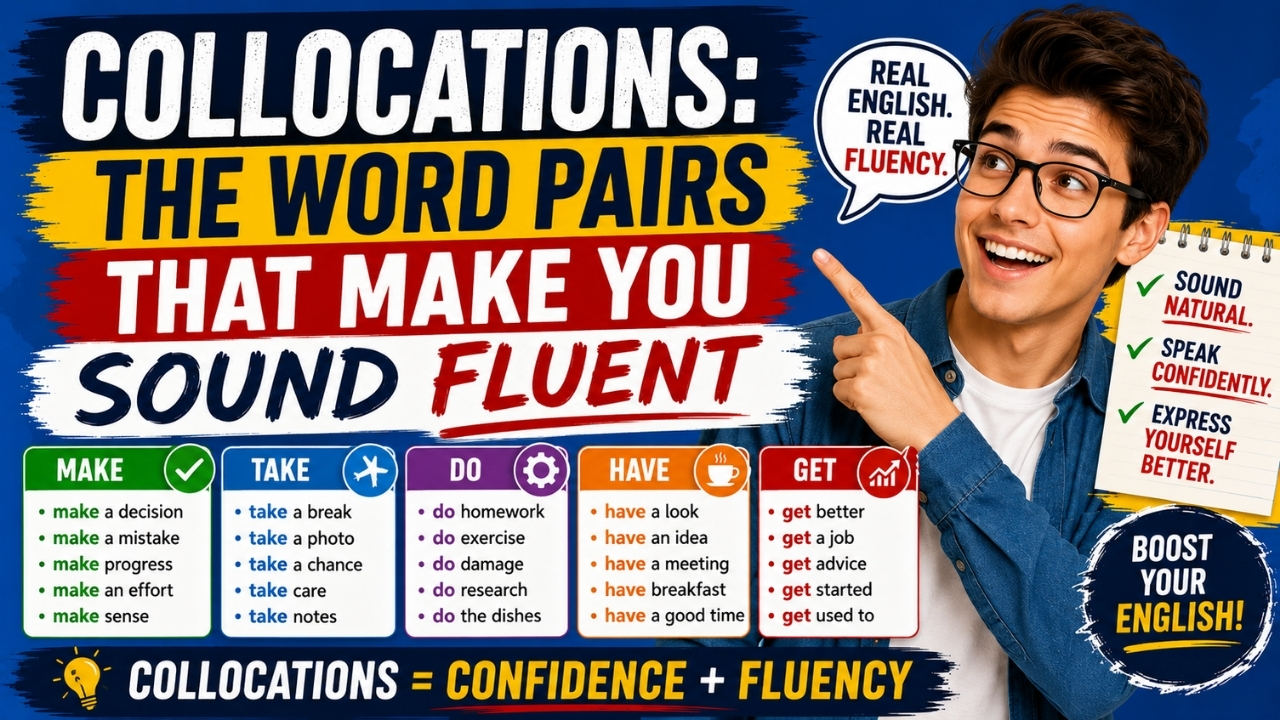
- make a decision, a mistake, an effort, friends, progress
- do homework, the dishes, business, a favour, research
- take a break, a photo, a risk, notes, your time
- have breakfast, a shower, a good time, a look
Notice how “make” and “do” both roughly mean “to perform an action,” yet they’re not interchangeable. You just have to learn which noun takes which.
Adjective + noun
- heavy rain, traffic, smoker
- strong coffee, accent, argument
- fast food, train, internet
Adverb + adjective
- fully aware, deeply sorry, highly unlikely, bitterly disappointed
Verb + adverb
- whisper softly, drive carefully, wait patiently
How to learn collocations
Record the chunk, not the word
This is the single most important habit. When you meet a new word, don’t write it alone. Write the whole natural phrase around it. Not risk, but take a risk. Not attention, but pay attention. Your notebook should be full of phrases, not lonely words.
Notice them everywhere
Once you know collocations exist, you start seeing them in everything you read and hear. Train yourself to spot word pairs — highlight them, say them aloud, and copy the exact combination rather than inventing your own. Imitation is the whole strategy here.
Use a collocations dictionary
There are dictionaries built specifically for this (search “online collocations dictionary”). When you’re not sure which verb goes with a noun, they’ll show you the natural options. They’re a brilliant tool for writing, especially before an exam.
A warning about translation
Most collocation errors come from translating directly from your first language. The word pairs that feel natural in your language often don’t transfer. “Make a party” might be correct word-for-word from your language, but in English it’s “throw a party” or “have a party.” Whenever a phrase feels like a direct translation, pause and check whether English actually pairs those words.
Why this is worth your time
Grammar gets all the attention, but collocations are often what separates an intermediate speaker from an advanced one. You can have flawless grammar and still sound foreign if your word pairings are off — and you can have shaky grammar but sound surprisingly natural if your collocations are strong.
Start small. Each time you learn a word, learn the company it keeps. Build a collection of natural phrases instead of isolated words, use them until they feel automatic, and your English will quietly start to sound like the real thing.