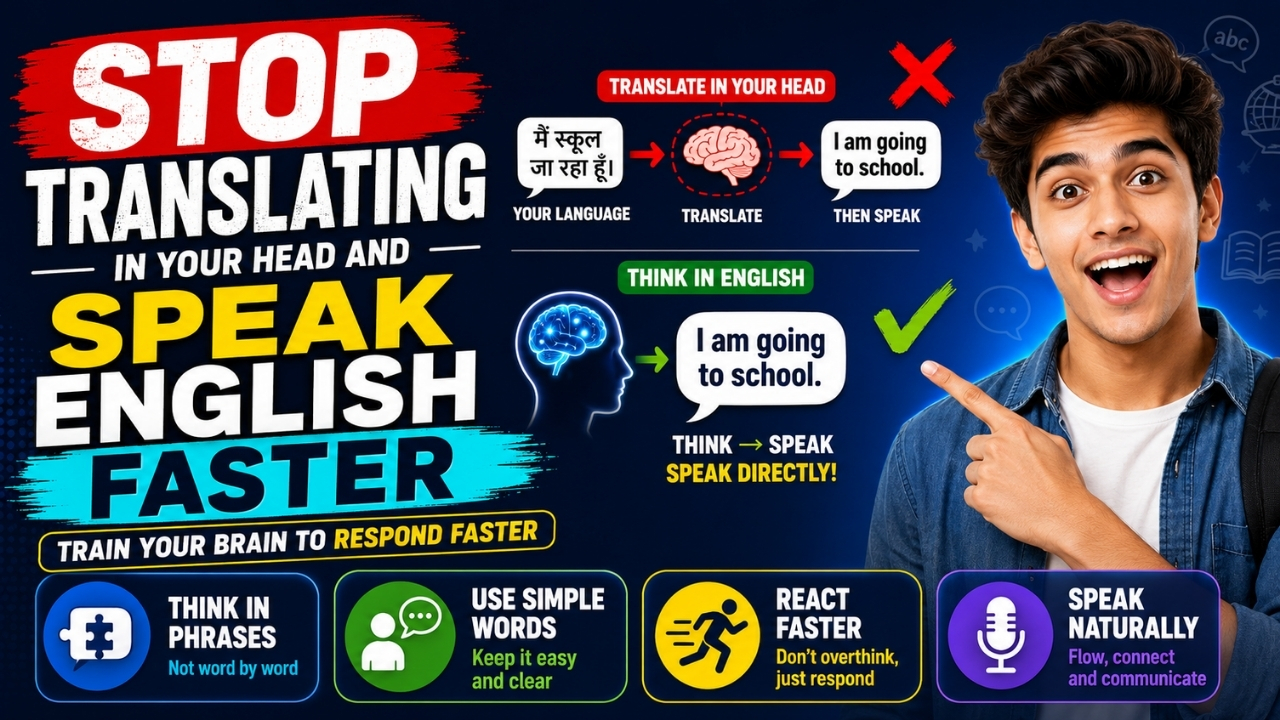
You know the feeling. Someone asks you a simple question in English, and before you can answer, a whole machine starts running in your head: you build the sentence in your own language, translate it word by word, check the grammar, and only then does it come out of your mouth — slow, late, and often a little wrong. By the time you’ve finished, the conversation has moved on. This habit of translating in your head is one of the biggest things holding fluent speech back, and the good news is you can train your way out of it.
Why translating feels safe but holds you back
Translating in your head feels responsible. You’re being careful, making sure it’s correct. But speech doesn’t happen at translation speed. A normal conversation moves quickly, and your brain simply can’t build a sentence in one language, convert it, and check it — all in the half-second you have to respond.
There’s a deeper problem, too. Languages don’t map neatly onto each other. Word order is different, idioms don’t transfer, and the “perfect” translation of your thought often sounds unnatural in English. So translating doesn’t just slow you down — it actively produces stranger sentences than thinking in English would.
What “thinking in English” really means
People throw around the advice “just think in English,” which is annoying when no one explains how. It doesn’t mean you suddenly have an inner monologue in flawless English. It means building a direct link between an idea and its English expression, with no detour through your first language.
When you see a cup of coffee, a fluent speaker doesn’t think of the word in their language and translate — the English word simply arrives. Building those direct links, one by one, is the whole project. And it’s completely trainable.
Start with your inner voice
Here’s a powerful habit: narrate your day to yourself in English, silently, as it happens. “I’m making breakfast. The kitchen is cold. I should buy more eggs.” It feels strange at first, and you’ll hit gaps constantly — words you don’t know, structures you can’t build. Those gaps are gold. They show you exactly what to look up, and because the need was real, the word sticks.
Do this for a few minutes a day and something shifts. English stops being a subject you study and becomes a tool you think with.
Learn in chunks, not single words
A big reason people translate is that they’re building sentences brick by brick, one word at a time. That’s exhausting and slow. Fluent speakers assemble speech from pre-made chunks — whole phrases they’ve heard so often that they come out automatically: “to be honest,” “I was just about to,” “it depends on.”
When you learn these ready-made phrases, you skip the construction process entirely. The chunk arrives whole, in English, with no translation needed. Collect them, repeat them aloud, and use them until they feel like reflexes.
Accept imperfection on purpose
Here’s an uncomfortable truth: the desire to be correct is often what keeps you translating. You’re so afraid of a mistake that you run everything through your careful mental checker first. But fluency and perfection pull in opposite directions. To speak faster, you have to let some errors through.
Give yourself permission to be imperfect. A slightly wrong sentence delivered confidently and on time is far more useful in a conversation than a perfect one that arrives ten seconds late. Native speakers make small mistakes constantly and don’t care. Copy that attitude.
Practise speaking under gentle pressure
Translation thrives when you have time. Take the time away, and you force your brain to find the direct route. Try answering questions out loud quickly, without preparing. Describe a photo for sixty seconds without stopping. Talk about your day for two minutes nonstop. The point isn’t to be perfect — it’s to keep moving so fast that there’s no room to translate. With repetition, your brain learns that the direct path is the only one that fits the time available.
Be patient with the process
Breaking the translation habit doesn’t happen in a week. For a while, you’ll catch yourself slipping back into it, especially when you’re tired or nervous. That’s normal. Every time you notice it and gently push yourself back toward thinking directly in English, you’re rewiring the habit a little more.
The learners who become genuinely fluent aren’t the ones who memorised the most grammar. They’re the ones who stopped using their first language as a middleman and let English become a direct line from thought to speech. Start narrating your life, collect your chunks, forgive your mistakes, and that line gets shorter every single day.