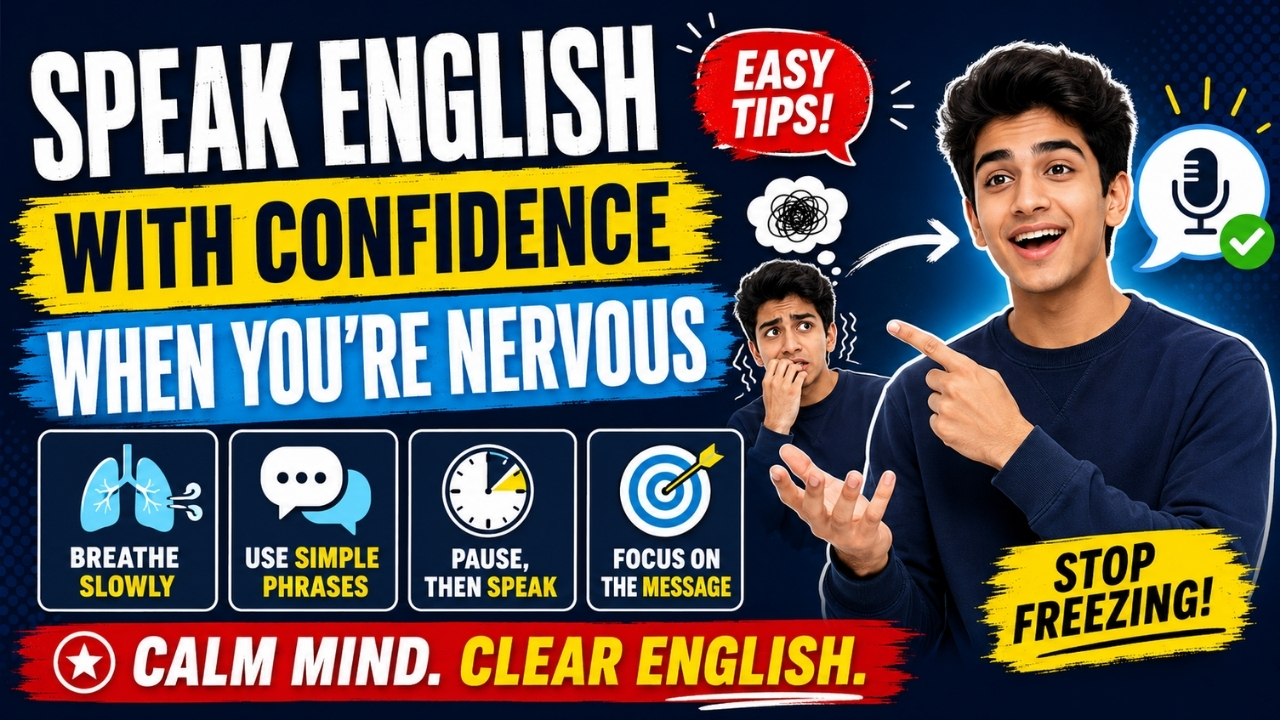
You’ve studied for years. You can read, you can write, you understand films. And then someone speaks to you in English and your mind goes blank, your heart races, and the words you definitely know simply refuse to come out. If this is you, you’re not alone — speaking anxiety is one of the most common and frustrating experiences in language learning. The encouraging part is that it’s a problem of mindset and habit far more than ability, and both can change.
Why your brain freezes
When you feel anxious, your body shifts into a stress response — the same ancient system designed to handle danger. Blood and focus rush toward survival and away from the parts of your brain that handle careful language production. So in the exact moment you most want to be articulate, your brain is least equipped to retrieve vocabulary. This is why you can know a word perfectly and still blank on it under pressure. It’s not stupidity; it’s biology.
Understanding this helps, because it means freezing isn’t proof you “can’t speak English.” It’s just nerves doing what nerves do. Calm the nerves and the language comes back.
Lower the stakes in your own head
A lot of speaking anxiety comes from imagining that mistakes are catastrophic — that people are silently judging every error. They’re almost never doing that. Native speakers, in particular, are usually impressed that you speak a second language at all, and they’re focused on your meaning, not your grammar.
Try reframing the goal. Your job in a conversation is not to be perfect. It’s to be understood. The moment you let go of perfection and aim only for communication, an enormous amount of pressure lifts, and the words start flowing more easily.
Make mistakes on purpose
This sounds backwards, but it’s one of the most freeing things you can do. Deliberately go into low-stakes situations where you’ll make mistakes — order food in English, ask a stranger for directions, join a language exchange. Each time you make an error and the world doesn’t end, your brain updates its belief that mistakes are dangerous. Over time, the fear simply has less and less evidence to feed on.
Prepare your “survival kit”
Confidence grows when you’re not starting from zero. Build a small kit of ready phrases you can deploy automatically, so you’re never completely stuck.
- Buying time: “Let me think for a second…”, “That’s a good question.”
- Asking for help: “Sorry, could you repeat that?”, “How do you say… in English?”
- Keeping going: “What I mean is…”, “In other words…”
When these are automatic, a moment of panic doesn’t leave you silent — you have something to say while your brain catches up. That single fact makes conversations feel far less threatening.
Don’t aim for impressive — aim for simple
Under pressure, many learners try to build complex, advanced sentences and collapse halfway through. Then they feel they’ve failed. The fix is to deliberately simplify. Short, clear sentences are not a weakness; they’re a strategy. A confident “I disagree. I think it’s too expensive.” communicates beautifully. You can always add complexity later, once the basics flow without fear.
Breathe before you speak
It’s simple and it genuinely works. When you feel the panic rising, take one slow breath before you respond. That breath does two things: it physically calms your stress response, and it buys you a second to gather your thoughts. Pausing to breathe doesn’t make you look unsure — it makes you look thoughtful. Native speakers pause all the time.
Practise speaking when it’s easy
You can’t build a habit only in the scary moments. Speak English when there’s no pressure at all — talk to yourself, narrate your day, record voice notes, read aloud. The more your mouth is used to forming English when you’re relaxed, the more reliably it works when you’re not. Speaking becomes a physical skill that’s simply there, rather than something you have to summon under stress.
Be kind to yourself
Finally, talk to yourself the way you’d talk to a friend who’s learning. You wouldn’t mock a friend for a small grammar slip; you’d encourage them. Yet many learners are brutally harsh with themselves, which only feeds the anxiety. Notice your progress instead of only your gaps. Every conversation you survive — clumsy or not — is a rep that makes the next one easier.
Confidence in speaking isn’t a personality trait you either have or don’t. It’s built, one slightly uncomfortable conversation at a time. Lower the stakes, prepare your phrases, breathe, simplify, and keep showing up. The nerves shrink, the words return, and one day you’ll realise you spoke without thinking about being afraid at all.