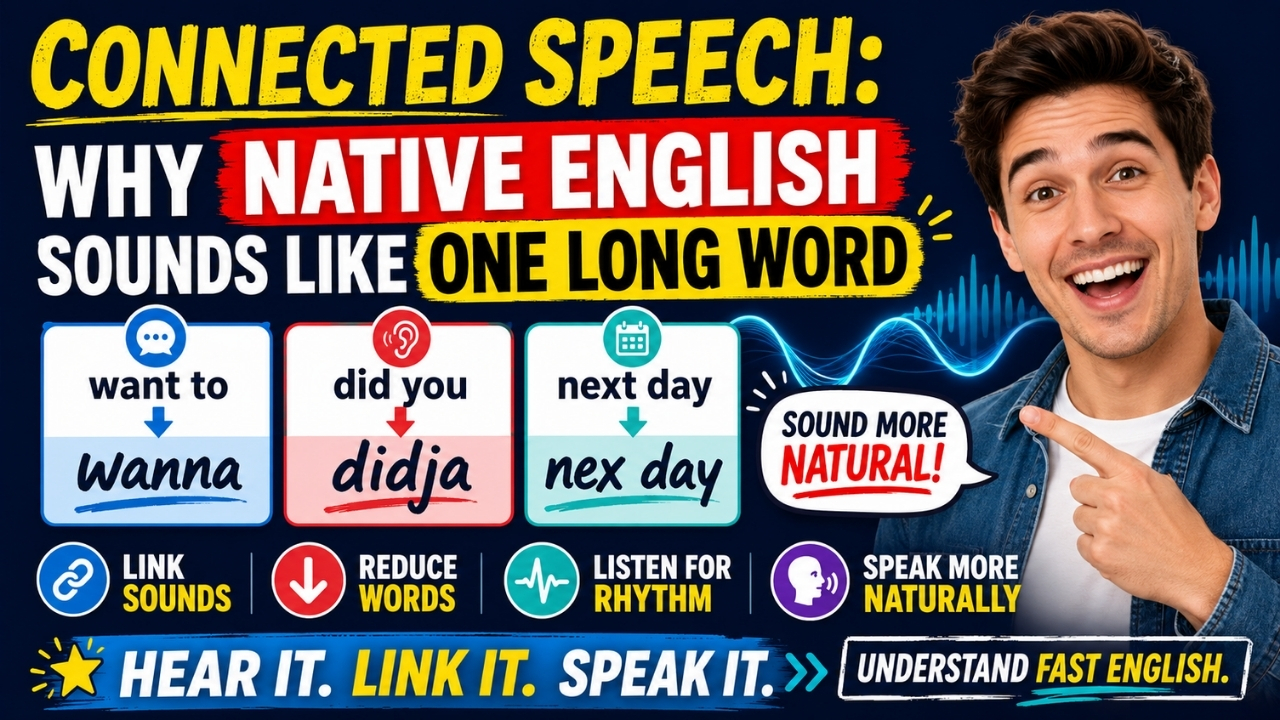
Have you ever understood every word in a textbook dialogue, then listened to two native speakers and felt completely lost — as if they were speaking a different language entirely? You’re not imagining it. In real, fast English, words don’t stay in their neat little boxes. They blend, shrink, and crash into each other in ways the written language never shows you. This is called connected speech, and understanding it is the missing key to both following native speakers and sounding like one.
Why textbook English misled you
When you learned English, words were presented one at a time, clearly and separately. “Do you want to go?” was four distinct words. But a native speaker says something closer to “d’ya wanna go?” — the words melt together into a stream. The careful, separated version you studied almost never happens in natural speech. That gap is exactly why real conversation feels so much faster and blurrier than the recordings in your coursebook.
How words blend: the main patterns
Connected speech isn’t random. It follows a few consistent patterns, and once you can name them, you start hearing them everywhere.
Linking: words holding hands
When one word ends in a consonant and the next begins with a vowel, English speakers glue them together. “An apple” becomes “a-napple.” “Turn it off” becomes “tur-ni-toff.” The boundary between the words simply disappears, which is a big reason you can’t tell where one word ends and the next begins.
Elision: disappearing sounds
Sometimes sounds just vanish to make speech smoother, especially “t” and “d” in the middle of clusters. “Next day” loses its “t” and becomes “nex day.” “Friendship” softens its “d.” Speakers drop these sounds without thinking, because pronouncing every one would slow them down.
Assimilation: sounds changing their neighbours
Sounds also change to blend more comfortably with what’s around them. “Ten boys” can sound like “tem boys,” because the “n” shifts toward the “b.” “Good boy” can become “goob boy.” Your mouth takes shortcuts, and one sound bends to match the next.
Weak forms: the shrinking small words
This is one of the most important patterns. Those little function words — to, of, and, for, can, was — usually get squashed into a tiny, quiet form built around the schwa. “Fish and chips” becomes “fish’n chips.” “A cup of tea” becomes “a cup’a tea.” “I can go” — where “can” almost disappears — sounds very different from “I can’t go,” where “can’t” is said fully. Learners who expect the full, strong version of these words often mishear the whole sentence.
Why this matters for listening
Here’s the crucial point: if you’re listening for the slow, separated words you studied, you’ll keep getting lost, because those words don’t exist in fast speech. Your brain is searching for something that isn’t there. Once you understand connected speech, you stop expecting neat boundaries and start recognising the blended stream for what it is. Suddenly, native speakers become far easier to follow — not because they slowed down, but because you finally know the rules they’re playing by.
Why this matters for speaking
Connected speech also explains why your own English might sound a little stiff even when it’s correct. If you pronounce every word fully and separately — “I… want… to… go” — you sound careful and unnatural, and ironically it can be harder for native speakers to follow, because it’s not the rhythm they expect. Letting your words link and blend a little makes you sound dramatically more fluent and, surprisingly, clearer.
How to train your ear and mouth
Listen with the transcript
Pick a short clip of natural speech and read along with the transcript as you listen. You’ll see “want to” on the page but hear “wanna,” and that gap between written and spoken is where the learning happens. Pause, rewind, and notice exactly how the words blend.
Shadow the blends, not just the words
When you imitate native speech (shadowing), don’t try to put the words back into their separate boxes. Copy the blending. Say “wanna,” say “fish’n chips,” let your words link. It feels sloppy at first, but it’s actually more accurate.
Start with the most common chunks
You don’t need to master every pattern at once. Begin with the high-frequency blends: gonna (going to), wanna (want to), gotta (got to), kinda (kind of). These appear constantly, and getting comfortable with them gives you an immediate boost in both listening and speaking.
Don’t panic about every detail
You don’t need to consciously memorise rules for elision and assimilation to benefit from them — mostly, you need to be aware they exist, so you stop expecting separated words and start absorbing the real thing through listening. The more natural English you hear with this awareness, the more your brain adjusts on its own.
Connected speech is the hidden layer that coursebooks rarely teach, and it’s often the single biggest reason advanced learners still struggle with fast conversation. Tune your ear to the blends, let your own words flow together, and the wall between you and natural English starts to come down.