Most writing problems aren’t really about vocabulary or grammar. They’re about organisation — and organisation starts at the paragraph. If your paragraphs are clear, your whole piece feels clear, even with simple language. If they’re messy, no amount of fancy words will save it. The reassuring part is that a strong paragraph follows a structure so predictable you can learn it in an afternoon and use it for the rest of your life.
What a paragraph actually is
A paragraph is a group of sentences that develop one single idea. That’s the whole definition, and the most important word in it is one. The classic mistake learners make is cramming several ideas into a single block of text, so the reader can’t tell what the point is. If you find yourself writing about two different things, that’s two paragraphs, not one.
Think of each paragraph as a small container with room for exactly one main idea, plus the support that idea needs. When the idea changes, you start a new container.
The three parts of a strong paragraph
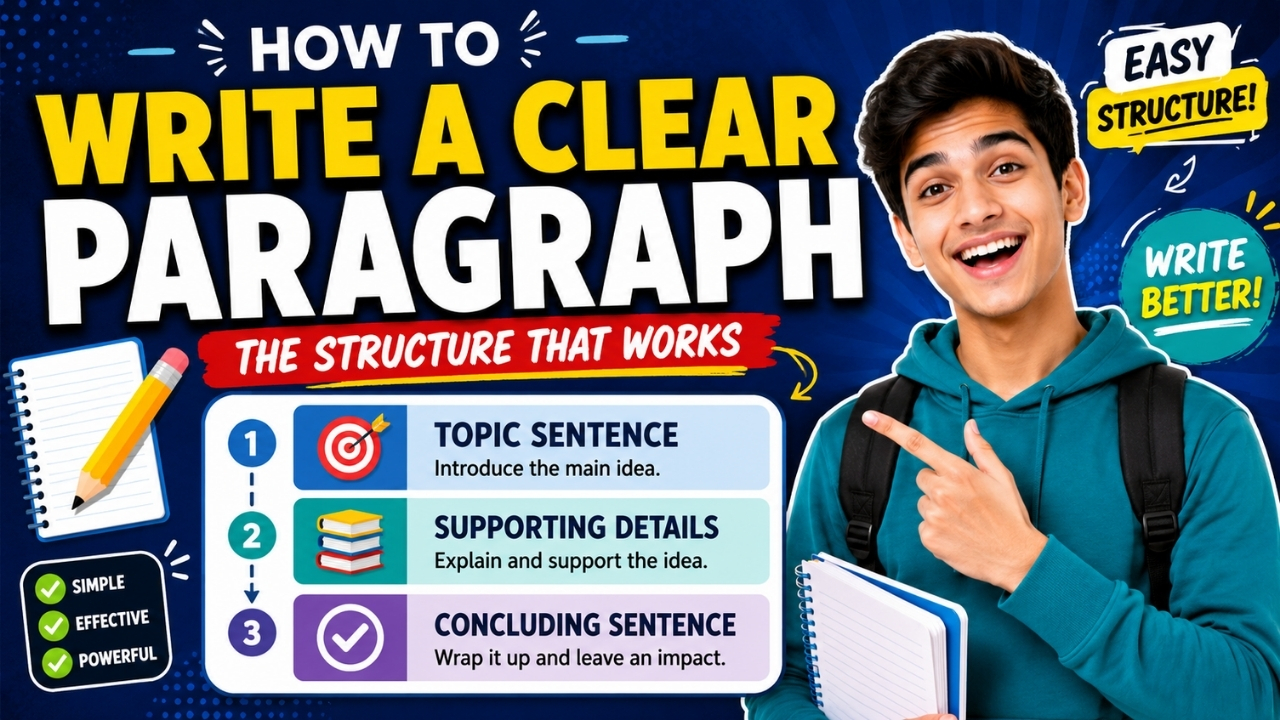
Almost every effective paragraph has the same three-part shape. Learn it once and you’ll never stare at a blank page wondering how to begin.
1. The topic sentence
The first sentence states the main idea of the paragraph. It tells the reader, up front, what this paragraph is about. Don’t make them guess or wait until the end — say it immediately.
For example: “Working from home has several clear advantages.” Now the reader knows exactly what’s coming, and everything that follows should support that one claim.
2. The supporting sentences
The middle of the paragraph develops the topic sentence. This is where you explain, give reasons, add details, or provide an example. These sentences answer the questions a reader naturally has: Why? How? Like what?
Continuing the example: “First, it removes the daily commute, saving both time and money. Many people gain back over an hour each day, which they can spend on family or rest. It also allows for a quieter environment, which can improve focus for certain kinds of work.”
Notice how every sentence connects back to the advantages of working from home. Nothing wanders off-topic.
3. The concluding or linking sentence
The final sentence either wraps up the idea or smoothly leads into the next paragraph. It gives the reader a small sense of closure before you move on.
“For these reasons, remote work has become a genuine preference, not just a convenience.” Simple, and it closes the loop.
The golden rule: one idea per paragraph
It’s worth repeating because it’s the rule learners break most often. If your topic sentence promises one thing, every other sentence in that paragraph must serve it. The moment you introduce a genuinely new idea, you’ve started a new paragraph — so press enter and begin again.
A quick test: try summarising your paragraph in a single short phrase. If you can (“the benefits of remote work”), it’s unified. If you need the word “and” to join two unrelated things (“remote work and office design”), you’ve packed in too much.
Keep your sentences varied but clear
Within the paragraph, mix up your sentence lengths. A series of identical short sentences feels choppy and childish; a wall of long, winding sentences exhausts the reader. The rhythm of clear writing usually alternates — a longer sentence to explain, then a short one to land the point. Read your paragraph aloud, and you’ll hear immediately where the rhythm breaks.
How long should a paragraph be?
There’s no magic number, but a useful guide is three to six sentences for most writing. Too short, and your idea probably isn’t developed enough. Too long, and you’ve likely smuggled in a second idea or started repeating yourself. If a paragraph is sprawling past eight or nine sentences, check whether it’s secretly two paragraphs wearing one coat.
Why this matters for exams and beyond
If you’re preparing for a writing exam, examiners specifically reward clear organisation — a strong topic sentence and focused support can lift your “coherence” score noticeably. But this skill reaches far beyond tests. Emails, reports, essays, and even messages all become easier to read when each paragraph does one job well. Clear paragraphs make you look like a clear thinker, which is exactly the impression you want to give.
Practise the structure deliberately
The fastest way to internalise this is to write short, single paragraphs on simple topics — your favourite food, why you’re learning English, a place you’d like to visit. Force yourself to use the three-part shape every time: topic sentence, support, closing. It feels mechanical at first, but within a couple of weeks the structure becomes instinct, and you’ll build clear paragraphs without even thinking about it. That’s when your writing starts to feel genuinely organised.