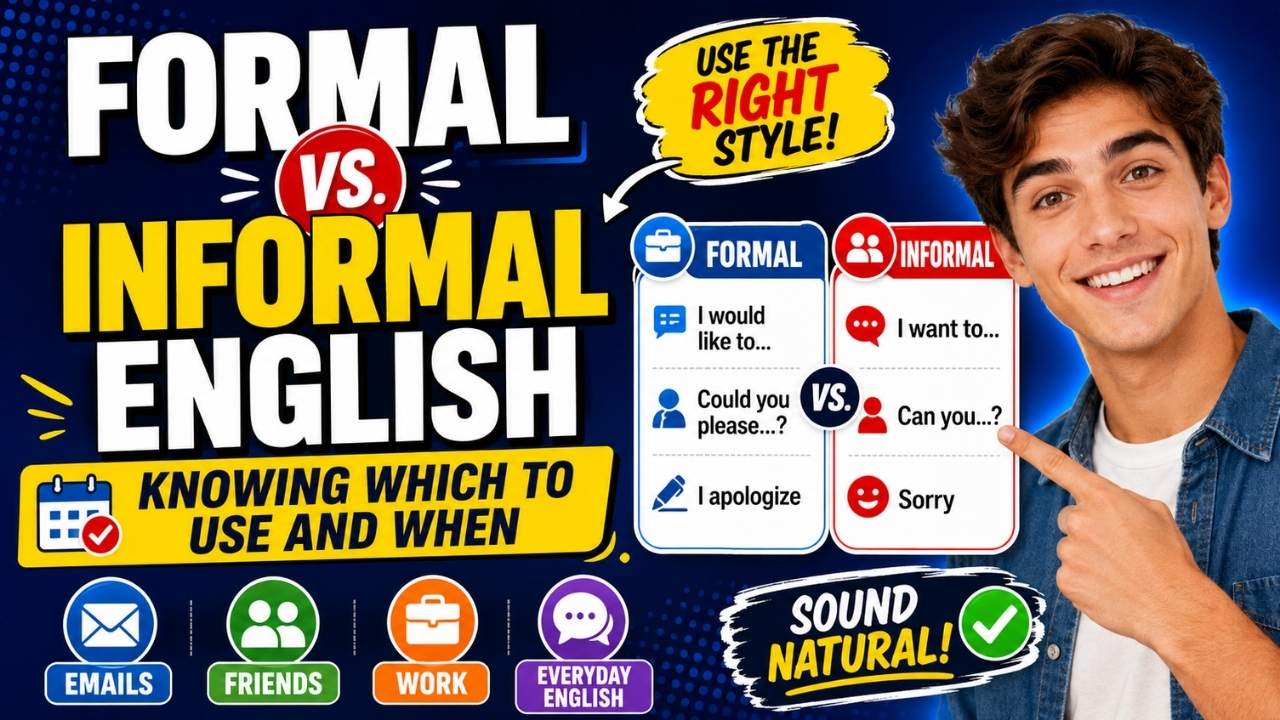
Imagine sending your boss a message that says “hey, gonna be late lol” — or writing to a close friend with “I am writing to inform you of my delayed arrival.” Both are technically correct English. Both are also completely wrong for the situation. Knowing when to be formal and when to be casual is a skill that native speakers use automatically, and it’s something learners can absolutely master with a little awareness.
Why register matters
The level of formality in language is called “register,” and getting it wrong has real consequences. Too casual in a professional setting, and you seem unprofessional or disrespectful. Too formal with friends, and you sound cold, distant, or even sarcastic. The words themselves might be perfect — it’s the tone that lands wrong.
The good news is that English gives you clear signals for each register. Once you learn them, you can dress your language up or down to fit any situation, like choosing the right clothes for an occasion.
Where you’ll use each
Formal English
Use it when there’s distance or seriousness involved: job applications and cover letters, emails to people you don’t know, academic essays, official documents, business reports, and communication with authority figures. The general rule: if you’d wear smart clothes for the situation, use formal language.
Informal English
Use it with friends, family, and close colleagues — in casual messages, social media, friendly chats, and relaxed conversation. This is the English of everyday life, and it’s where contractions, slang, and a warm, personal tone belong.
The key differences
Several concrete features separate formal from informal English. Learn these and you can shift register on purpose.
Contractions
- Informal: “I’m, don’t, can’t, it’s, we’ll”
- Formal: “I am, do not, cannot, it is, we will”
Spelling out contractions instantly makes writing feel more formal. In casual writing, contractions make you sound natural and human.
Vocabulary
Formal English often prefers a single, more “serious” verb where informal English uses a phrasal verb.
- Informal: “find out, put off, get, need, help out”
- Formal: “discover, postpone, receive, require, assist”
Neither is better in general — they just suit different settings. “Could you assist me?” fits a formal email; “Can you help me out?” fits a message to a friend.
Slang and idioms
Casual language is full of slang (“cool,” “awesome,” “a bit”), abbreviations (“lol,” “btw”), and relaxed idioms. Formal writing avoids almost all of these. You’d never write “btw, the results were awesome” in a report; you’d write “Additionally, the results were excellent.”
Sentence length and structure
Formal writing tends toward longer, more complete sentences and avoids fragments. Informal writing happily uses short bursts, fragments, and even one-word replies (“Sure!” “No way!”).
How you address people
- Formal: “Dear Mr Smith,” “Dear Sir or Madam,” “Yours sincerely”
- Informal: “Hi Sam,” “Hey,” “Cheers,” “Talk soon”
The greeting and sign-off alone often set the entire tone.
A side-by-side example
Look at the same message in both registers.
Informal: “Hey, sorry but I can’t make it tomorrow. Something came up. Can we do another day? Let me know!”
Formal: “Dear Ms Lee, I am writing to apologise that I will be unable to attend tomorrow’s meeting due to an unexpected commitment. Would it be possible to reschedule? I look forward to your reply.”
Same information, completely different feeling. One is a friend; one is a professional contact. Choosing the wrong one would send the wrong signal.
The danger of mixing them
A common learner mistake is blending registers in a single piece — starting an email with a formal “Dear Sir” and then dropping in “gonna” or “lol.” This mismatch is jarring and can undermine an otherwise good piece of writing. Once you pick a register, stay consistent throughout.
How to develop a feel for it
Register is learned best through exposure and noticing. When you read a formal email, a news article, a text from a friend, and a social media post, pay attention to how different they feel and why. Collect formal phrases for professional situations and casual phrases for relaxed ones, almost like building two separate toolkits.
When you’re unsure which to use, err slightly on the formal side with people you don’t know well — it’s safer to be a little too polite than too casual. And remember that being formal doesn’t mean being complicated. The clearest formal writing is still simple; it’s just respectful and complete. Master this switch, and you’ll communicate appropriately in any situation English throws at you.