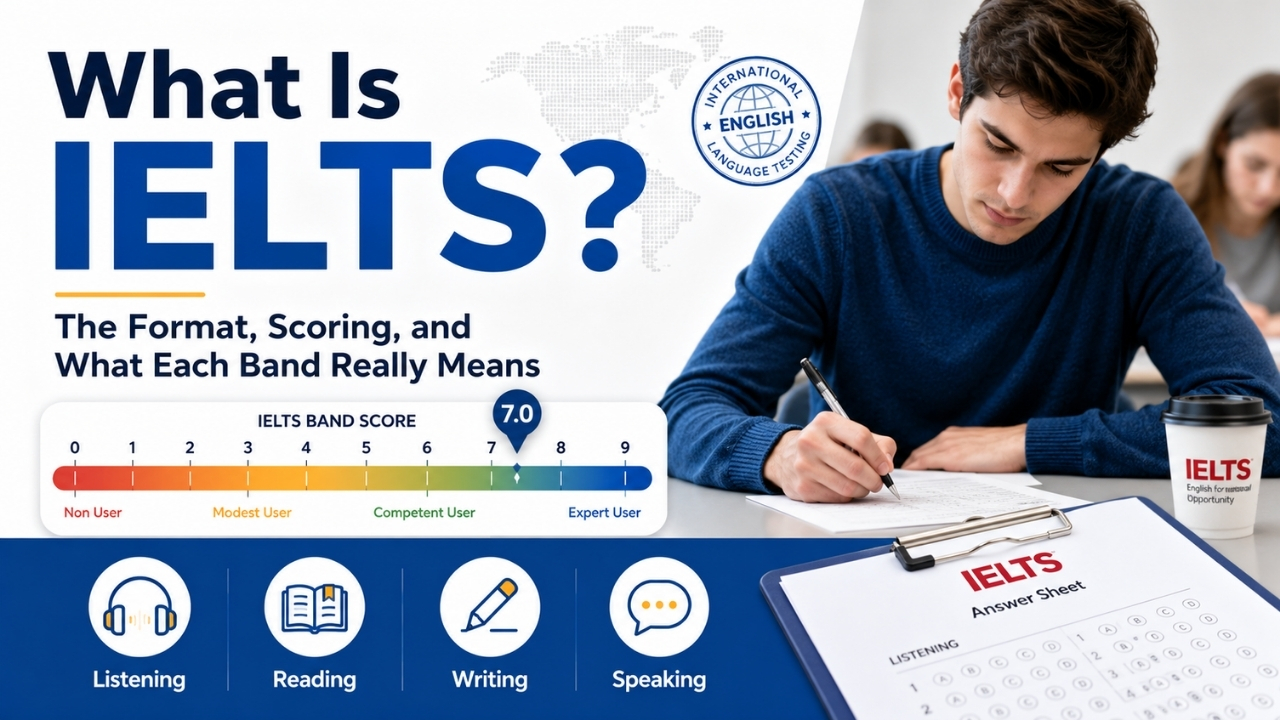
If you’ve just decided to take IELTS, the first thing you’ll notice is that everyone throws numbers at you. “You need a 6.5.” “I got an overall 7 but a 5.5 in writing.” It’s confusing, and nobody really stops to explain what any of it means. So let’s fix that.
IELTS — the International English Language Testing System — measures how well you can use English in four skills: listening, reading, writing and speaking. There are two versions. Academic is for university and professional registration. General Training is usually for work and migration. The Listening and Speaking parts are the same in both; Reading and Writing differ. Pick the wrong one and you may have to sit the test again, so check what your university or visa actually requires before you book.
What the test day looks like
Four parts, in this rough order:
- Listening — about 30 minutes, 40 questions, four recordings that get harder as you go. You hear each one only once.
- Reading — 60 minutes, 40 questions. Academic has three long passages; General Training has shorter, more everyday texts.
- Writing — 60 minutes, two tasks. Task 1 is shorter; Task 2 is an essay and counts for more.
- Speaking — an 11 to 14 minute face-to-face (or video) interview with a real examiner, often on a separate day.
That’s a lot of English in one sitting, which is exactly why preparation matters more than raw vocabulary.
How scoring actually works
This is the part people get wrong. You get a band score from 0 to 9 for each of the four skills, in half-point steps (6.0, 6.5, 7.0 and so on). Your overall band is the average of those four, rounded to the nearest half band.
Here’s the bit that surprises people: a strong reading score can quietly rescue a weaker writing score. Say you get Listening 7, Reading 7.5, Writing 6, Speaking 6.5. The average is 6.75, which rounds up to an overall 7.0 — even though one skill was only a 6. The flip side is just as real: many universities and visa routes set a minimum per skill, so an overall 7 won’t help if they demand at least 6.5 in writing and you scored 6. Always read the small print.
What the bands roughly mean
- Band 5 — modest user. You manage basic communication but make frequent mistakes.
- Band 6 — competent. You handle most situations, with some errors. This is the floor for many undergraduate courses.
- Band 7 — good user. You’re fluent and accurate most of the time. This is what a lot of postgraduate programs and skilled-visa routes ask for.
- Band 8+ — very good to expert. Rare, and usually not necessary.
For Listening and Reading, your band comes from how many of the 40 questions you get right — roughly the low 30s puts you around a 7, though the exact cut-off shifts slightly between tests. Writing and Speaking are judged by examiners against four published criteria each, which is why “just write more” isn’t a strategy.
Where to start
Before you buy a single practice book, do one thing: take a full timed practice test, all four sections, no breaks. It’ll feel uncomfortable. That’s the point — it shows you where your real weak spot is, which is almost never where you assumed. Build your study plan around that, and you’ll save yourself weeks of studying the wrong thing.