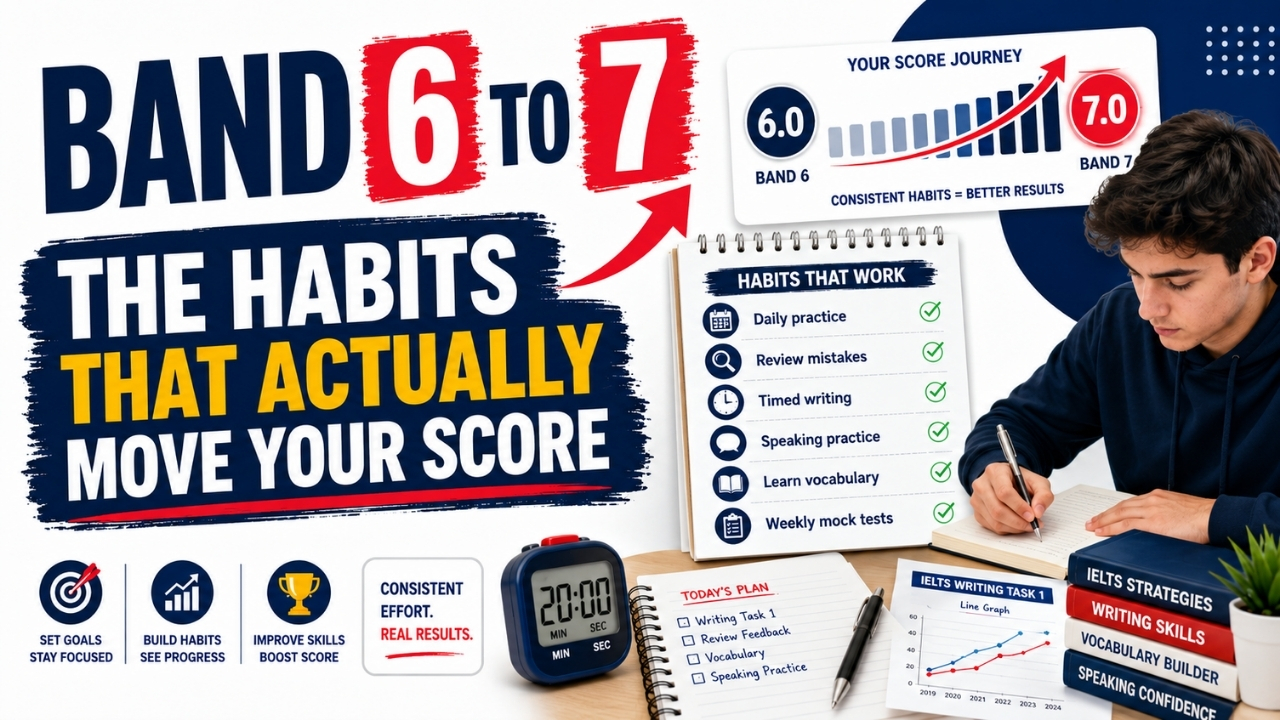
There’s a wall a lot of learners hit, and it’s almost always in the same place: band 6.5. You can communicate, you understand most of what you read and hear, and yet that 7 keeps slipping out of reach. I’ve seen this enough times to say something blunt: the jump from 6 to 7 is rarely about learning more English. It’s about cleaning up what you already do.
Accuracy beats ambition
At band 6, people tend to reach for big, impressive words and complicated sentences — and make a mess of them. At band 7, the examiner sees someone who writes and speaks accurately, even if the language is a touch simpler. A clean, correct sentence beats an ambitious one full of errors every time. So before you learn another fancy phrase, get rock-solid with the basics: articles (a/the), subject-verb agreement, and the right tense. These “small” errors are exactly what hold a 6 back from a 7.
Fix the leaks you can’t hear
Most learners have two or three errors they repeat constantly without noticing — dropping the ‘s’ on third-person verbs, mixing up “make” and “do,” forgetting articles. These are your real ceiling. The fastest way to find them is to record yourself speaking and write a few practice essays, then get honest feedback, ideally from someone who knows the band descriptors. You can’t fix a leak you can’t hear.
Read and listen to real English daily
Not textbooks — real things. A podcast on the train, a few news articles with your coffee, a YouTube channel you actually enjoy. Band 7 fluency comes from exposure, the kind where natural phrasing soaks in without you studying it. Ten focused minutes a day beats a four-hour cram on Sunday.
Practise under real conditions
You’d be amazed how many people prepare for months and never once do a full, timed test in one sitting. Then exam day arrives and the pressure wrecks them. Simulate it. Timer on, phone away, all four sections. The discomfort is the training.
Be specific, not vague
Whether you’re writing an essay or answering a speaking question, vague answers sound like a 6 and specific ones sound like a 7. “Pollution is bad” is band 6. “Traffic pollution in big cities has been linked to higher rates of asthma in children” is band 7 — same idea, but concrete. Train yourself to follow every general statement with a specific example.
The mindset shift
Stop trying to sound impressive and start trying to be clear and correct. That’s the whole secret, really. Band 7 isn’t a more decorated version of band 6 — it’s a tidier, more accurate, more specific one. Build these habits over a few weeks and the score tends to follow on its own.