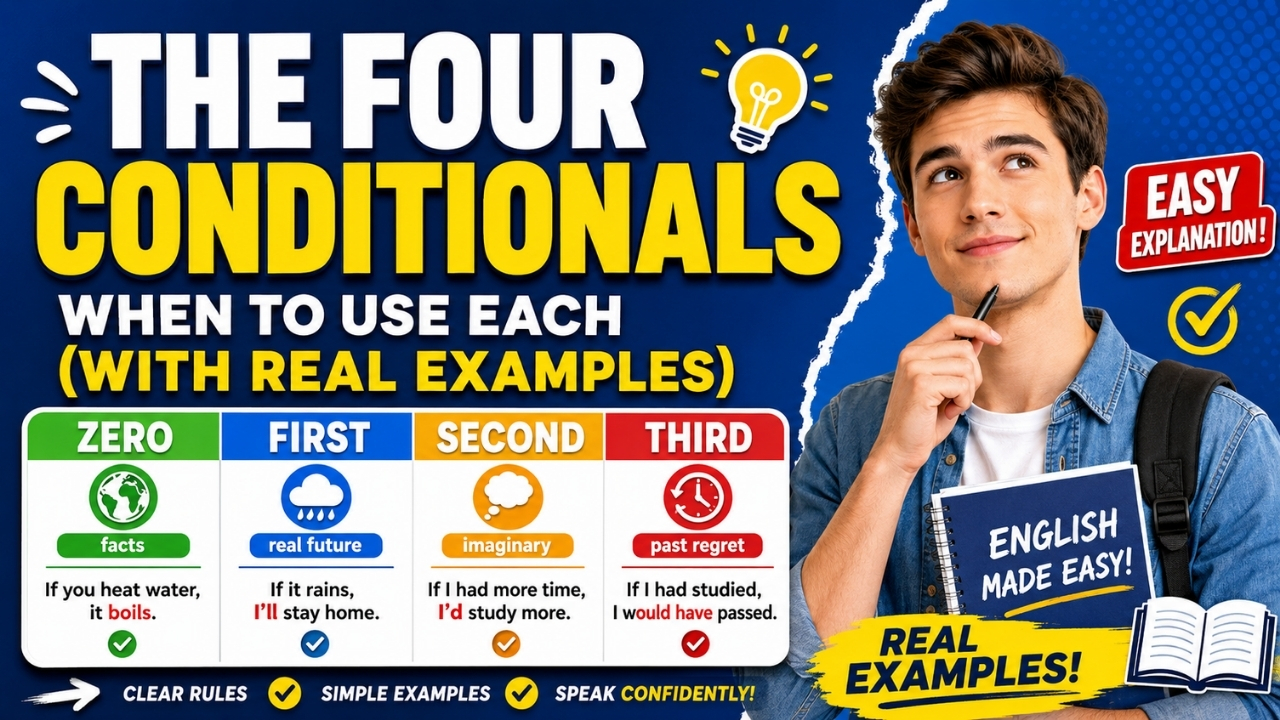
“If” sentences trip up learners at every level, mostly because English has four main patterns and they look deceptively similar. The secret is that each conditional answers a different question about how real or likely something is. Once you match the pattern to the meaning, the grammar follows naturally.
What a conditional actually is
A conditional sentence has two parts: a condition (the “if” part) and a result. “If it rains, I’ll stay home.” The “if” part sets up a situation; the result tells you what happens because of it. The four types differ in when the situation happens and how possible it is.
The zero conditional: things that are always true
Form: If + present simple, present simple.
Use it for facts, general truths, and things that always happen the same way. There’s no doubt involved — it’s cause and effect.
- “If you heat ice, it melts.”
- “If I don’t sleep, I feel terrible the next day.”
- “Plants die if you don’t water them.”
A neat detail: in the zero conditional, you can usually replace “if” with “when” and the meaning barely changes, because it’s about something reliable and repeated.
The first conditional: real future possibilities
Form: If + present simple, will + base verb.
Use it for situations that are genuinely possible in the future. You’re talking about a real plan or a likely outcome.
- “If it rains tomorrow, I ‘ll stay home.”
- “If you study hard, you ‘ll pass the exam.”
- “She ‘ll be upset if you forget her birthday.”
Notice the “if” part uses the present, not “will” — this is one of the most common mistakes. We don’t say “If it will rain”; we say “If it rains.” Keep “will” in the result half only.
You can swap “will” for other modals to change the tone: “If you finish early, you can leave.” “If you see him, you should say hello.”
The second conditional: unreal or unlikely present
Form: If + past simple, would + base verb.
This is where people get nervous, but the idea is simple: you’re imagining something that isn’t true now or is very unlikely. The past tense here doesn’t mean the past — it signals “this is imaginary.”
- “If I had a million dollars, I ‘d travel the world.” (But I don’t have it.)
- “If I were you, I ‘d apologise.” (But I’m not you.)
- “She would be happier if she changed jobs.” (She probably won’t.)
A classic point: with the verb “to be,” careful speakers use were for every subject in the second conditional — “If I were rich,” “If he were here.” You’ll hear “was” in casual speech, but “were” is the safe, correct choice in writing and exams.
The third conditional: imagining a different past
Form: If + past perfect, would have + past participle.
Use it to talk about the past differently from how it actually happened — regrets, missed chances, what could have been. Nothing here is changeable; it’s pure imagination about a closed past.
- “If I had studied harder, I would have passed.” (But I didn’t study, so I failed.)
- “If we had left earlier, we wouldn’t have missed the train.” (But we left late.)
- “She would have called you if she had known.” (But she didn’t know.)
It’s a mouthful at first, but the meaning is emotionally clear: this is what would have been true, if only the past had been different.
Mixed conditionals (a quick note)
Sometimes the two halves live in different times. “If I had studied medicine (past), I would be a doctor now (present).” Here a past condition has a present result. You don’t need to master these early — just know they exist, so they don’t confuse you when you meet them.
A simple way to choose
Ask two questions:
- Is it about the past, present, or future?
- Is it real or imaginary?
- Always true → zero conditional.
- Real future → first conditional.
- Imaginary present → second conditional.
- Imaginary past → third conditional.
Practising them properly
Don’t drill them as isolated grammar exercises forever. Instead, use them to talk about your own life: a fact about your body (zero), a plan for tomorrow (first), a daydream about being rich (second), a regret from last year (third). When the grammar is attached to a real thought, it sticks far better than any worksheet. Do this for a week and the four patterns stop blurring together.