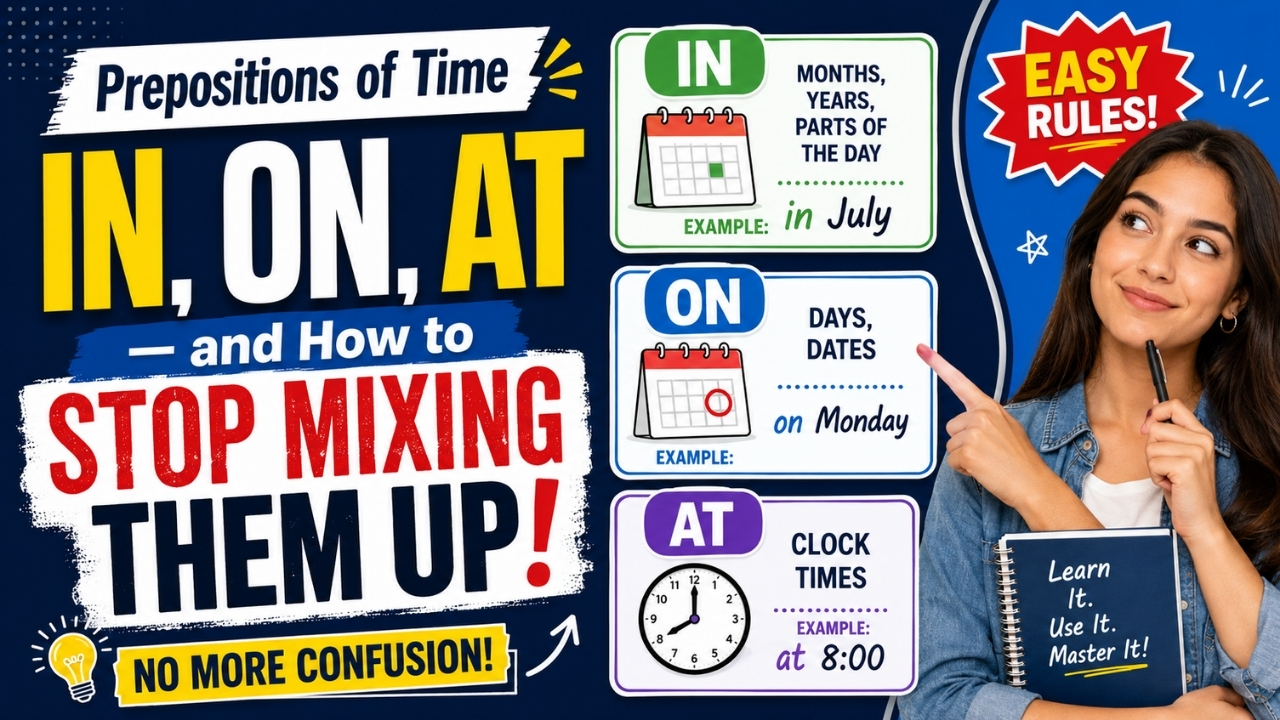
Few things feel as frustrating as prepositions. There’s rarely a deep logic to memorise, and your own language probably divides time differently, so direct translation just doesn’t work. The reassuring news: for time, the prepositions in, on, and at follow a pattern that’s surprisingly learnable. Let’s break it down from biggest to smallest.
The size rule that mostly works
Think of time like a set of containers, from large to small:
- in → long periods (months, years, seasons, parts of the day)
- on → specific days and dates
- at → precise points (clock times, exact moments)
Picture it as zooming in. You start “in” a wide stretch of time, narrow down to a particular day “on,” and pinpoint an exact moment “at.” That mental image alone solves most cases.
Using ‘in’ for long periods
Use in with anything that feels like a broad block of time:
Months, years, centuries
- “My birthday is in May.”
- “She was born in 1995.”
- “The castle was built in the 14th century.”
Seasons
- “We travel a lot in summer.”
- “In winter, the days are short.”
Parts of the day
- “I work best in the morning.”
- “He gets home in the evening.”
A length of time before something happens
- “I’ll be ready in ten minutes.” (After ten minutes pass.)
Using ‘on’ for days and dates
Use on whenever you’re naming a specific day — and that includes dates, named days, and special days.
Days of the week
- “The meeting is on Monday.”
- “I don’t work on Sundays.”
Dates
- “Her interview is on the 5th of July.”
- “We met on March 3rd.”
Special days and named days
- “We give gifts on Christmas Day.”
- “I’ll call you on your birthday.”
A useful pairing to memorise: when “morning,” “afternoon,” or “evening” is attached to a specific day, you switch from in to on. So it’s “in the morning” in general, but “on Monday morning” or “on the morning of the wedding.” The specific day pulls it into on territory.
Using ‘at’ for precise points
Use at for exact clock times and specific moments.
Clock times
- “The train leaves at 9 o’clock.”
- “Let’s meet at half past six.”
Specific points and short events
- “I woke up at midnight.”
- “She gets nervous at the start of every exam.”
Fixed expressions
A handful of common phrases use at even though they don’t look like clock times — these are just worth learning as fixed chunks:
- at night
- at noon / at midnight
- at the weekend (British English)
- at Christmas / at Easter (the whole holiday period, not the single day)
- at the moment
The exceptions that catch everyone
This is where learners lose confidence, so let’s face the tricky ones directly.
- “at night” but “in the morning/afternoon/evening.” Yes, it’s inconsistent. Night gets at; the others get in. There’s no satisfying reason — just memorise it.
- “at the weekend” (UK) vs. “on the weekend” (US). Both are correct; they just belong to different varieties of English. Pick one and be consistent.
- “at Christmas” vs. “on Christmas Day.” At Christmas means the general festive period; on Christmas Day means the 25th specifically.
Words that take no preposition at all
Don’t add in, on, or at before these time words — it’s a very common error:
- this, that, next, last, every, all
So it’s “I’ll see you next week” (not “on next week”), “She called this morning” (not “in this morning”), and “We meet every Friday” (not “on every Friday”). The little time word already does the job.
The fastest way to lock it in
Prepositions resist pure memorisation, so feed your brain real examples instead. When you read or listen in English, notice how in, on, and at attach to time, and copy those exact phrases. Better yet, narrate your own schedule out loud: “I get up at seven, I study in the afternoon, I rest on Sundays, my exam is in June.” Repeat your real timetable enough times and the right preposition starts arriving automatically — which is exactly how native speakers do it, without ever thinking about the rule.