Some English words look or sound so similar that even native speakers get them wrong every single day. The mistakes are understandable, but they’re also exactly the kind of thing that makes writing look careless. The reassuring part is that each of these pairs has a simple trick to keep them straight. Learn the trick once, and the confusion is gone for good.
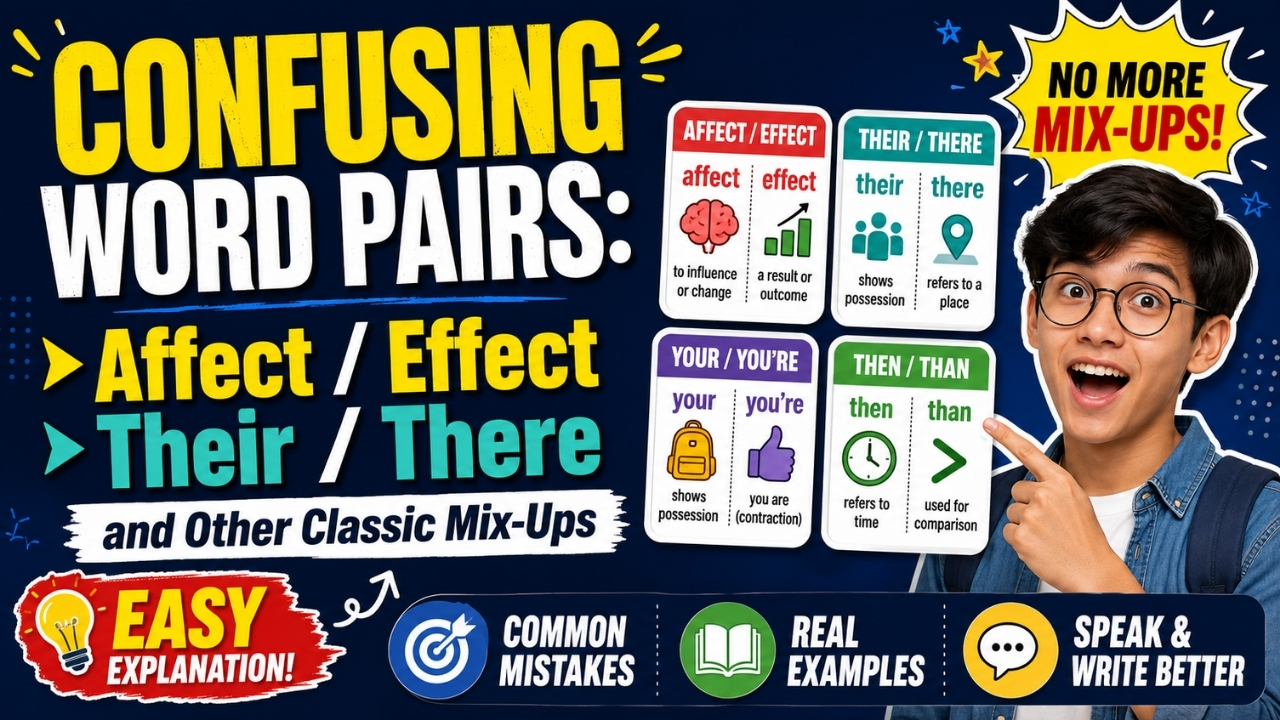
Affect vs. effect
This is the most famous mix-up in English, and the rule is simpler than people fear.
- Affect is usually a verb (an action). It means to influence something. “The weather affects my mood.”
- Effect is usually a noun (a thing). It means the result. “The weather has an effect on my mood.”
The trick: Affect is an Action (verb); Effect is the End result (noun). If you can put “the” or “an” in front of it, you want effect. If it’s something happening, you want affect.
Their, there, and they’re
Three words, identical sound, completely different jobs.
- Their shows possession. “Their house is huge.” (It belongs to them.)
- There is about place. “The keys are over there.” (A location.)
- They’re is short for “they are.” “They’re late again.” (They + are.)
The tricks: their has the word “heir” in it, which is about owning. There contains “here,” which is about place. And they’re always unpacks into “they are” — if that doesn’t fit, it’s wrong.
Your vs. you’re
The same trap in a smaller package.
- Your shows possession. “Is this your bag?”
- You’re means “you are.” “You’re so kind.”
The trick: if you can replace it with “you are,” use you’re. “You are so kind” works, so it’s you’re. “Is this you are bag?” doesn’t work, so it’s your.
Its vs. it’s
This one breaks the usual rule and trips up almost everyone. Normally an apostrophe shows possession — but not here.
- Its shows possession. “The dog wagged its tail.”
- It’s means “it is” or “it has.” “It’s raining.”
The trick: the apostrophe in it’s is doing the same job as in “don’t” or “can’t” — it replaces a missing letter. So if you can say “it is” or “it has,” use it’s. Otherwise, the possessive its has no apostrophe, just like his and hers don’t.
Then vs. than
A single letter, two unrelated meanings.
- Then is about time or sequence. “We ate, then we left.”
- Than is for comparisons. “She’s taller than me.”
The trick: then and time both have an “e.” Than and comparison… well, just remember that comparing always uses than. “Bigger than,” “better than,” “more than” — always the “a.”
Lose vs. loose
These get swapped constantly in writing.
- Lose (one “o”) is a verb. It means to misplace something or not win. “Don’t lose your ticket.”
- Loose (two “o”s) is an adjective. It means not tight. “These trousers are too loose.”
The trick: loose has an extra “o” — picture it as so loose that an extra letter fell in. Lose lost an “o,” which is fitting for a word about losing.
Advice vs. advise
Same word family, different jobs, and the pronunciation gives it away.
- Advice (with a “c,” sounds like “ice”) is a noun. “Let me give you some advice.”
- Advise (with an “s,” sounds like “ize”) is a verb. “I advise you to wait.”
The trick: the “c” version is the thing (noun); the “s” version is the action (verb). Say them aloud — the soft “s” sound signals the verb.
To, too, and two
A quick trio to finish.
- To shows direction or goes before a verb. “I’m going to work.” / “I want to sleep.”
- Too means “also” or “excessively.” “I’m tired too.” / “It’s too hot.”
- Two is the number 2. “I have two sisters.”
The trick: too has an extra “o” — it’s the “excessive” one, with too many letters. Two with a “w” is always the number.
How to make these stick
Reading the rules is the easy part; not slipping up under pressure is harder. Pick the one or two pairs you personally get wrong most often — everyone has their weak spots — and focus only on those. Write a memorable example sentence for each and keep it somewhere visible. Then proofread your writing specifically hunting for those words. Within a couple of weeks, the correct choice starts feeling obvious, and one of the most common sources of careless errors quietly disappears from your English.