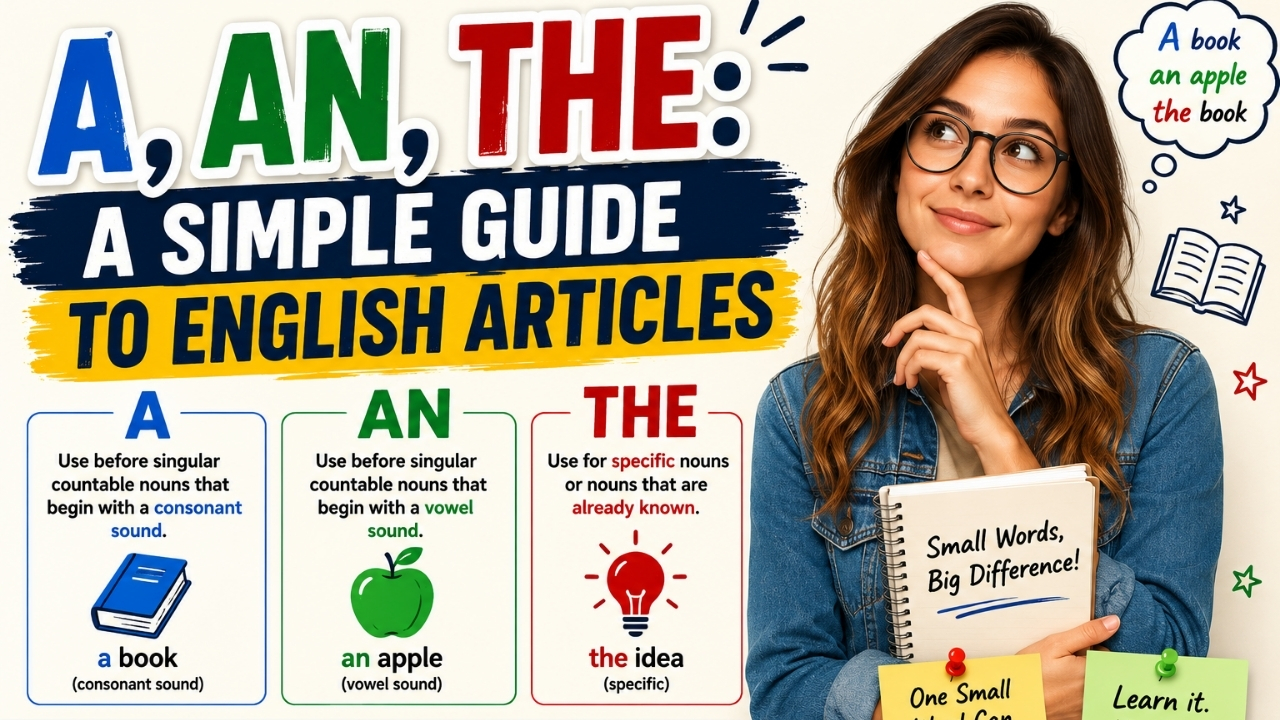
For such small words, articles cause an astonishing amount of trouble — especially if your first language doesn’t use them. The difference between “a dog,” “the dog,” and just “dog” feels invisible at first, yet getting it wrong is one of the quickest ways to sound less fluent than you are. Let’s make it make sense.
The big picture
English has three options, and you choose based on one question: does the listener know exactly which thing you mean?
- a / an — one of many, not specific, or mentioned for the first time
- the — a specific one that both you and the listener can identify
- no article (zero article) — talking about things in general
Hold onto that question — “do they know which one?” — and most decisions answer themselves.
A vs. an: it’s about sound, not spelling
Both a and an mean the same thing. You choose between them based on the sound that follows, not the letter.
- Use a before a consonant sound: a car, a house, a university (it sounds like “yoo”), a European trip.
- Use an before a vowel sound: an apple, an hour (the “h” is silent), an MBA (it sounds like “em”).
Notice “a university” and “an hour” break the letter rule — because what matters is how the word is spoken. Say the word aloud and let your ear decide.
When to use ‘a’ or ‘an’
Use them with singular, countable nouns when the noun is:
Not specific — any one will do
- “I need a pen.” (Any pen. I don’t care which.)
- “She’s looking for an apartment.” (Not a particular one yet.)
Mentioned for the first time
- “I saw a dog in the park.” (You don’t know which dog — it’s new information.)
This is the classic pattern: introduce something with a/an, then switch to the once it’s known.
When to use ‘the’
Use the when the listener can identify exactly which thing you mean. That happens in several ways.
The second time you mention something
- “I saw a dog in the park. The dog was chasing a cat.” (Now we both know which dog.)
When there’s only one
- “Please close the door.” (There’s one obvious door.)
- “The sun is bright today.” (There’s only one sun.)
- “He’s the president of the company.” (Only one.)
With superlatives and ordinals
- “It’s the best film I’ve seen.”
- “She was the first person to arrive.”
When context makes it obvious
- “I’m going to the bank.” (My usual bank — you know the one.)
When to use no article at all
This is the part learners forget. With plural and uncountable nouns used in a general sense, you use no article:
- “Dogs are loyal.” (Dogs in general — not “the dogs.”)
- “Water is essential.” (Water in general.)
- “I love music.” (Music in general.)
Compare: “I love the music in this film.” Now it’s specific, so the comes back.
You also drop the article with most names, languages, meals, and many places:
- “I speak Spanish.” (not “the Spanish”)
- “We had lunch.” (not “a lunch”)
- “She lives in France.” (no article with most countries)
But watch the exceptions: “the United States,” “the Netherlands,” and “the UK” all take the, because they’re built on plural or descriptive words.
A quick test you can run
When you’re unsure, ask yourself two questions in order:
- Is it specific — can the listener identify exactly which one? If yes, use the.
- If not, is it one countable thing? If yes, use a/an. If it’s plural or uncountable and general, use no article.
Run “____ coffee is expensive here” through it: not a single specific coffee, uncountable, general → no article. “Coffee is expensive here.” Run “I’d like ____ coffee” → one serving, not yet specific → “a coffee.”
Why it’s worth the effort
Articles are the kind of detail that examiners notice and that quietly shapes how natural you sound. The rules feel fiddly now, but they become automatic with exposure. Read in English, notice the little words, and copy what you see. Within a few weeks, “a,” “an,” and “the” stop being decisions and start being instinct.