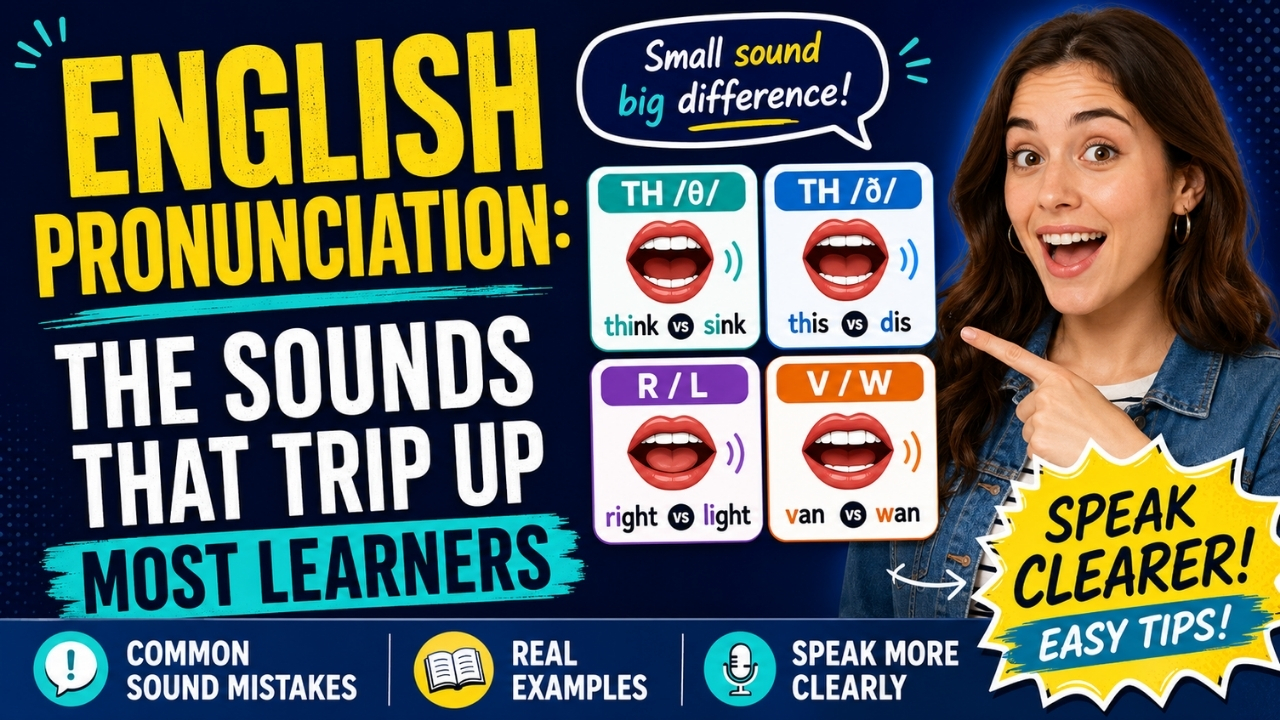
English pronunciation has a reputation for being unfair, and honestly, it earns it. The spelling rarely matches the sound, and several English sounds simply don’t exist in many other languages — so your mouth has never learned to make them. The result is a handful of sounds that trip up learners everywhere. Let’s look at the worst offenders and, more importantly, how to actually fix them.
Why some sounds are so hard
When you learned your first language as a baby, your mouth and ears specialised in its specific sounds. Any sound that wasn’t in that language never got practised, so as an adult, those unfamiliar sounds feel physically awkward — your tongue genuinely doesn’t know where to go. This isn’t a talent problem; it’s a training problem, and muscles can be trained.
The “th” sound (two of them, actually)
The notorious “th” is the sound learners struggle with most, partly because it exists in very few languages. There are actually two versions: the soft one in think and bath, and the buzzy one in this and mother.
The fix is almost embarrassingly physical: put the tip of your tongue lightly between your teeth and push air past it. For the this version, add your voice so your throat buzzes. Many learners replace “th” with a “t,” “d,” “s,” or “z” sound — saying “dis” for this or “tink” for think. Practise slowly in front of a mirror; if you can see your tongue tip peeking out, you’re doing it right.
“R” and “L”
For some learners these two blur together, and for others the English “r” is the challenge. The English “r” is made without the tongue touching the roof of the mouth — it curls back slightly and hovers. The “l,” by contrast, has the tongue tip pressed firmly behind the top teeth.
Practise them in pairs to feel the difference: right / light, rock / lock, correct / collect. Say them slowly, exaggerating the tongue position, until the contrast becomes clear and automatic.
“V” and “W”
These two are a classic mix-up. The difference is all in the lips. For “v,” your top teeth touch your bottom lip and you add a buzz — it’s almost like an “f” with your voice on. For “w,” your lips round into a small circle and your teeth never touch your lip at all.
Try minimal pairs like vest / west and vine / wine. Watch your lips in a mirror: teeth-on-lip for “v,” rounded-and-free for “w.”
The short “i” versus the long “ee”
This pair causes real misunderstandings. The short, relaxed sound in ship, bit, and live is completely different from the long, tense sound in sheep, beat, and leave. Mix them up and “I want to live here” can come out as “I want to leave here” — opposite meanings.
For the long “ee,” stretch your lips into a wide smile and tense them. For the short “i,” keep your mouth relaxed and the sound quick. Practising pairs like ship / sheep and fit / feet trains your ear and your mouth at once.
The schwa: the most important sound you’ve never heard of
Here’s a secret that changes everything: the most common vowel sound in English isn’t a, e, i, o, or u. It’s a lazy, neutral “uh” called the schwa, and it hides inside unstressed syllables everywhere — the “a” in about, the “o” in common, the “er” in teacher.
Learners often pronounce every vowel fully and clearly, which sounds robotic and unnatural. Native speakers reduce unstressed vowels to this quiet “uh.” Once you start using the schwa in the weak syllables, your English instantly sounds smoother and more natural — often more than fixing any single consonant does.
How to practise without going in circles
Use minimal pairs
Minimal pairs are words that differ by just one sound — ship/sheep, vest/west, think/sink. Practising them sharpens both your ear and your mouth, because you’re forced to hear and produce the exact difference.
Record yourself and compare
Find a short clip of a native speaker, record yourself saying the same thing, and listen back to back. It’s uncomfortable, but it reveals gaps you genuinely cannot hear in the moment. Then imitate, again and again.
Slow down before you speed up
You can’t fix a sound at full conversational speed. Practise the hard word slowly and correctly first. Speed comes naturally once your mouth knows the movement.
Progress over perfection
You don’t need a flawless accent — that’s not the goal, and very few adult learners ever reach it. The goal is to be clearly understood, and to stop the specific sounds that cause confusion or make people ask you to repeat. Pick the one or two sounds that cause you the most trouble, drill them with minimal pairs and a mirror, and you’ll see noticeable improvement faster than you’d expect. Pronunciation is muscle memory, and muscles always respond to practice.