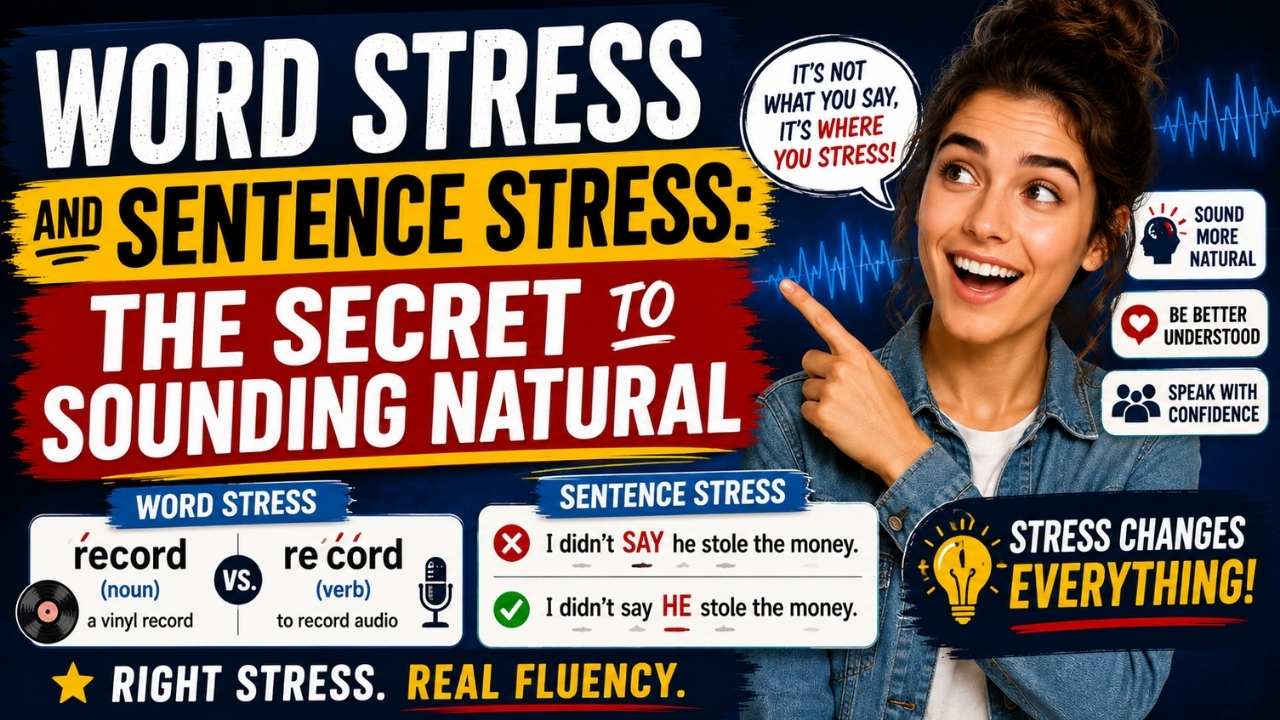
Here’s something that surprises a lot of learners: you can pronounce every individual sound in English correctly and still sound foreign. The missing ingredient is almost always stress — the rhythm of which parts you say loudly and which you say quietly. Stress is the music of English, and once you understand it, your speech starts to sound dramatically more natural, sometimes overnight.
What stress actually is
When we “stress” a syllable or word, we make it longer, louder, and higher in pitch than the parts around it. English is built on this contrast between strong and weak. Some syllables get emphasised and stretched; others get squashed down into that quiet “schwa” sound we mentioned earlier. This push and pull is what gives English its characteristic rhythm.
Many languages give every syllable roughly equal weight. English doesn’t, and speaking it with even, equal syllables is one of the biggest reasons an accent sounds “off,” even when the sounds themselves are correct.
Word stress: every word has a strong part
In any English word of two or more syllables, one syllable is stressed and the others are weaker. We say BA-na-na, not ba-NA-na or ba-na-NA. Put the stress in the wrong place and the word can become genuinely hard to understand — listeners rely on that stress pattern to recognise the word at all.
Stress can even change the meaning
This is the part people find fascinating. Some English words are spelled identically but change their meaning depending on which syllable you stress — usually flipping between a noun and a verb.
- RE-cord (noun: a vinyl record) vs. re-CORD (verb: to record something)
- PRE-sent (noun: a gift) vs. pre-SENT (verb: to present)
- OB-ject (noun: a thing) vs. ob-JECT (verb: to disagree)
The general pattern: the noun takes stress on the first syllable, the verb on the second. Get it wrong and you might say you want to “gift” something when you meant to “give it as a gift” — your listener has to work harder to follow you.
How to learn word stress
When you learn a new multi-syllable word, learn its stress at the same time, as part of the word itself. Say it aloud and exaggerate the strong syllable. A good dictionary marks the stressed syllable for you. Treat the stress pattern as essential information, not an optional extra.
Sentence stress: not every word is equal
Word stress is only half the story. Within a whole sentence, some words are stressed and others are swallowed. The trick is knowing which is which, and English follows a clear logic.
Content words get stressed
The words that carry meaning — nouns, main verbs, adjectives, adverbs — are spoken clearly and strongly. These are the words a listener needs to understand your message.
Function words get reduced
The small grammar words — articles (a, the), prepositions (to, of, at), pronouns, auxiliary verbs (is, are, was) — are usually said quickly and quietly, often with that lazy schwa sound. They glue the sentence together but don’t carry the core meaning.
Take the sentence: “I’m going to the shop to buy some bread.” A native speaker hammers shop, buy, and bread, while “I’m going to the” and “to” and “some” get compressed into a quick mumble. That uneven rhythm is exactly what natural English sounds like. If you give every word equal weight, you sound mechanical, even if every sound is correct.
Stress for emphasis
There’s one more layer. You can move the stress to whichever word you want to highlight, and it changes the meaning of the whole sentence.
- “I didn’t say she stole the money.” (Someone else said it.)
- “I didn’t say she stole the money.” (Someone else stole it.)
- “I didn’t say she stole the money.” (Maybe she borrowed it.)
Same words, completely different messages — all decided by where the stress lands. Native speakers do this instinctively, and learning to use it makes you a far more expressive speaker.
How to train your rhythm
Listen like a drummer
Pick a short clip and listen only for the rhythm — where the strong beats fall. Tap the table on each stressed word. You’ll start to hear the heartbeat of English underneath the words.
Shadowing
Play a sentence, then immediately repeat it, copying the rhythm and melody as closely as you can — not just the words, but the ups and downs. This technique, called shadowing, trains your mouth to produce natural stress patterns rather than flat, even ones.
The payoff
Of all the things you can work on, stress often gives the biggest, fastest improvement in how natural you sound. It’s the difference between speaking English and speaking it like a textbook read aloud. Listen for the rhythm, exaggerate the strong beats, and let the small words shrink. Your English will start to flow — and people will find you much easier to understand.