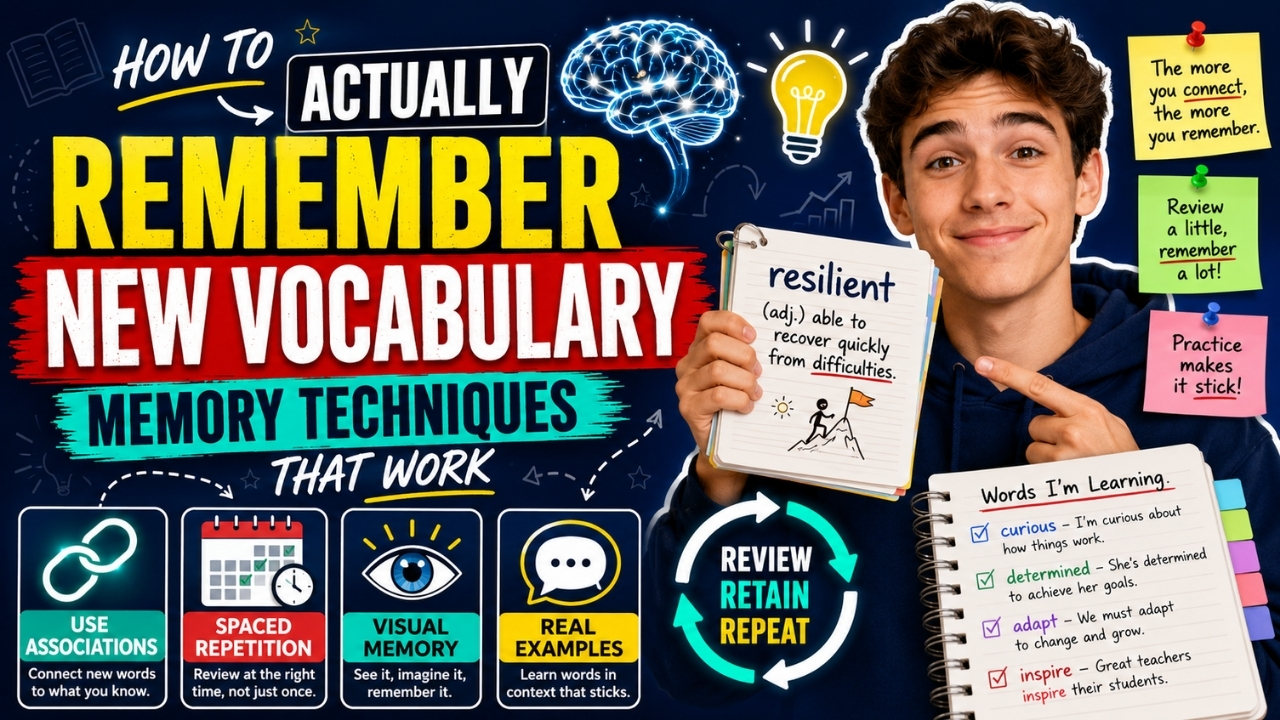
Everyone knows the feeling. You look up a word, understand it perfectly, feel satisfied — and three days later it’s vanished without a trace. Forgetting isn’t a sign that you’re bad at languages. It’s just how memory works. The trick is to study in a way that fights forgetting instead of ignoring it. Here’s how.
Why you forget (and why it’s normal)
Over a century ago, a psychologist named Hermann Ebbinghaus mapped what he called the “forgetting curve.” His finding was blunt: we forget most new information within days unless we review it. That sounds depressing, but it’s actually the key to the solution. If forgetting follows a predictable curve, then reviewing at the right moments can flatten it. You don’t need a better memory — you need better timing.
Technique 1: Spaced repetition
This is the most powerful vocabulary tool ever invented, and it’s based directly on the forgetting curve. Instead of cramming a word ten times in one evening, you review it at increasing intervals: after a day, then a few days, then a week, then a month. Each review comes just as you’re about to forget, which forces your brain to strengthen the memory.
Apps like Anki or Quizlet automate this for you — they track which words you find hard and show them more often, while easy words appear less. Twenty minutes of spaced repetition a day will outperform hours of cramming, because it works with your memory instead of against it.
Technique 2: Learn words in context, never alone
A word on its own is an abstract symbol with nothing to hold onto. A word inside a sentence has meaning, emotion, and a situation attached — and those hooks are what memory grabs.
So instead of memorising “reluctant = unwilling,” learn it inside a sentence: “She was reluctant to leave the warm bed on a cold morning.” Now the word has an image, a feeling, a scene. When you need it later, the whole scene comes back and drags the word along with it. Always learn vocabulary in a phrase or sentence, ideally one that means something to you personally.
Technique 3: Make it visual and strange
Your brain loves images, and it loves the unusual. You can exploit both. When you learn a new word, picture something vivid — and the weirder, the better. To remember that “gloomy” means dark and sad, imagine a rain cloud sitting indoors over one miserable person’s head. Silly images are sticky precisely because they’re surprising.
For words that sound like something in your own language, build a quick mental bridge. If a word’s sound reminds you of another word, link the two with a little story. These “memory hooks” feel childish, but they work astonishingly well.
Technique 4: Use the word, fast
There’s a huge gap between a word you recognise and a word you can produce. To cross it, you have to use the word soon after learning it — ideally within a day. Write your own sentence with it. Drop it into a journal entry, a message, or a conversation. The act of producing the word, rather than just reading it, tells your brain this is something worth keeping.
A good rule: a word isn’t really yours until you’ve used it three times in your own sentences.
Technique 5: Connect new words to old ones
Memory is a web, not a list. New information sticks better when it’s tied to things you already know. So when you learn a new word, link it to its family: synonyms, opposites, and related forms. Learn “generous,” and connect it to “generosity,” “stingy” (its opposite), and “kind” (a synonym). Each connection is another thread holding the word in place.
Technique 6: Review actively, not passively
Re-reading your vocabulary list feels like studying, but it’s mostly an illusion — your eyes glide over familiar words and your brain does little work. Active recall is far stronger. Cover the meaning and try to remember it. Test yourself. Struggle a little. That effort of pulling the answer from memory is exactly what strengthens it. Easy review teaches you almost nothing; difficult recall teaches you a lot.
Putting it together
You don’t need all six techniques at once. Start with two that fit your life: spaced repetition for timing, and learning in context for depth. Add visual hooks for stubborn words, and always, always use new words quickly.
The learners who build big, lasting vocabularies aren’t gifted with better memories. They’ve just stopped studying in ways that guarantee forgetting, and started studying in ways that guarantee remembering. Do the same, and the words will finally stay.