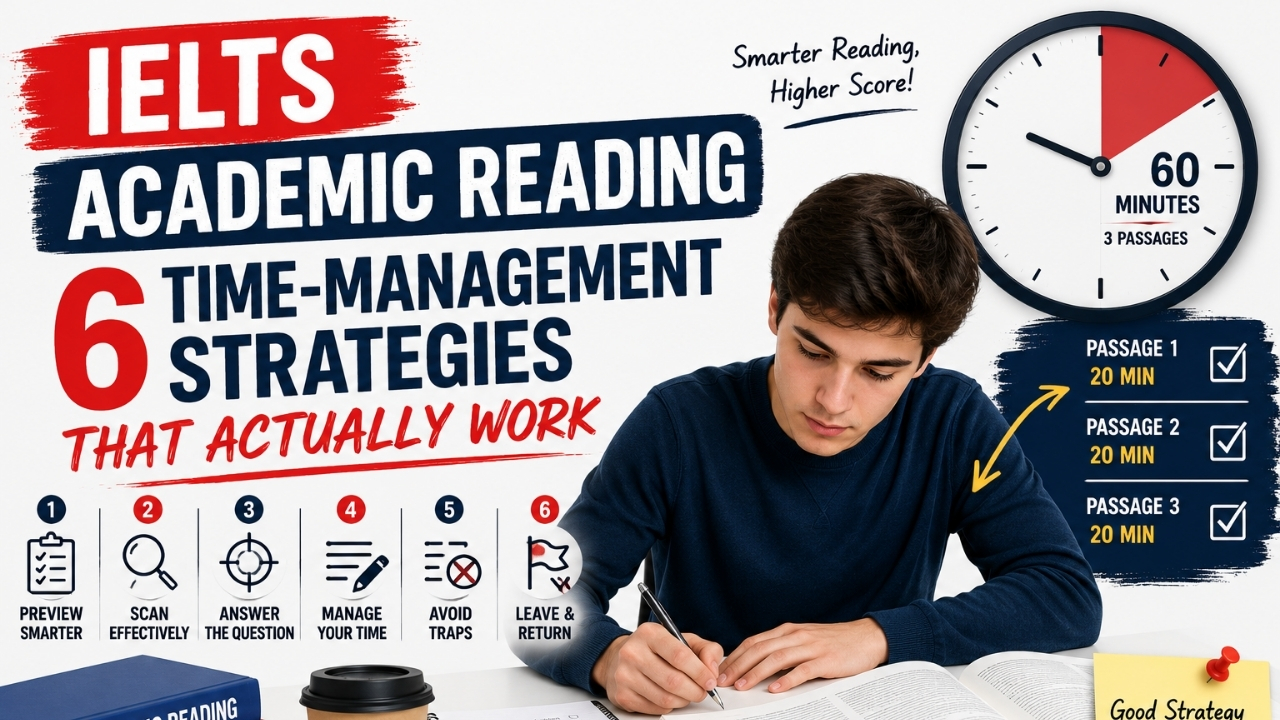
The Academic Reading test isn’t really a reading test. It’s a time test. Three long passages, 40 questions, 60 minutes, and — unlike the paper Listening section — no extra time to transfer your answers. Plenty of people understand every passage perfectly and still don’t finish. If that’s you, the fix isn’t better English. It’s a better plan.
1. Budget 20 minutes per passage, then move
This is the rule that saves scores. Twenty minutes each, and when the time’s up, you move on whether you’re finished or not. The questions are not ordered by difficulty across passages — there are easy marks waiting in passage three, and it’s a tragedy to miss them because you over-invested in one hard question in passage one.
2. Don’t read the whole passage first
It feels responsible to read every word before looking at the questions. It’s also a great way to run out of time. Instead, skim the passage for 2–3 minutes to get the gist and structure — what each paragraph is roughly about — then go straight to the questions and read closely only the parts you actually need.
3. Learn to scan for specific words
Many questions hand you a name, a date, or an unusual word to hunt for. Train your eyes to sweep the text for that exact word rather than reading sentence by sentence. When you spot it, slow down and read carefully around it. That’s where the answer lives.
4. Do “True/False/Not Given” last — and trust it
These questions eat time and nerves. The key distinction: False means the text contradicts the statement; Not Given means the text simply doesn’t say. Don’t use your own outside knowledge — only what’s on the page. If you can’t find it stated either way, it’s Not Given, and second-guessing usually makes it worse.
5. Answer the easy questions first within each passage
Question types like matching headings or completing a summary often follow the order of the text, while others jump around. Grab the straightforward ones first to bank the marks, then circle back to the time-eaters.
6. Never leave a blank
Same as Listening — there’s no penalty for wrong answers. With two minutes left, fill every empty box with your best guess. A blank is a guaranteed zero; a guess is a free chance.
The honest truth about practice
You won’t get faster by reading more slowly and carefully. You get faster by doing timed passages over and over until skimming and scanning feel natural. Set a timer at 20 minutes per passage from day one of your prep, even when it hurts. By exam day, working at that pace should feel normal rather than frantic — and that calm is worth half a band on its own.