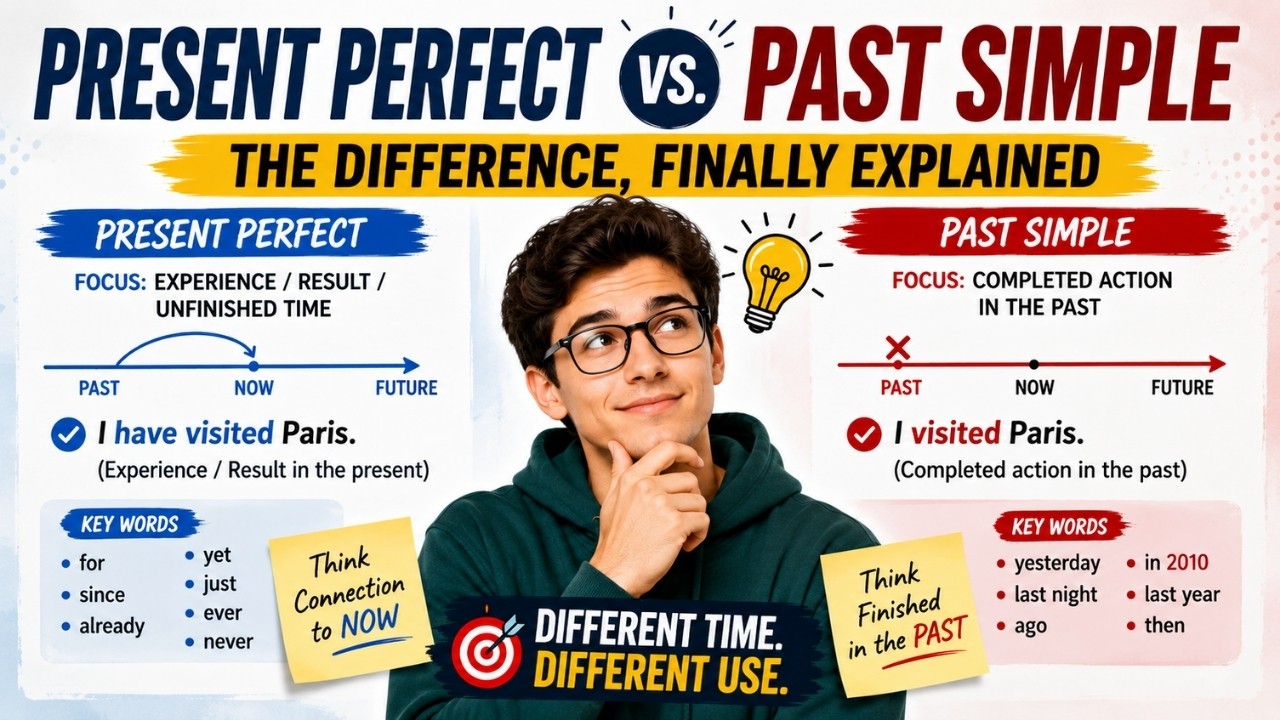
If there’s one grammar point that quietly haunts English learners for years, it’s this one. You’ve probably been taught the rules a dozen times, nodded along, and then frozen the moment you had to choose between “I lived in London” and “I have lived in London.” The good news is that the difference comes down to one simple idea — and once it clicks, you stop guessing.
The one idea that explains everything
Here it is: the past simple talks about finished time, the present perfect connects the past to now.
The past simple lives entirely in the past. The action happened, it’s over, and there’s usually a moment in time attached to it — yesterday, last year, in 2015, when I was a child. That moment is closed.
The present perfect, on the other hand, keeps one foot in the present. The action happened at some point before now, but you’re talking about it because it matters now — maybe because of the result, the experience, or the fact that the time period isn’t finished yet.
Compare these two:
- “I lost my keys yesterday.” (Past simple — finished. Yesterday is over. Maybe I found them already.)
- “I have lost my keys.” (Present perfect — the result matters now. I still can’t get into my house.)
Same event, different focus. The past simple reports it; the present perfect tells you it’s still relevant.
When to use the past simple
Use it whenever the action is finished and you’re thinking about a specific past time — even if you don’t say the time out loud, it’s understood.
- “She graduated in 2019.”
- “We watched a film last night.”
- “He called you an hour ago.”
- “Did you enjoy the party?”
The giveaway words are all about finished time: yesterday, last week, last year, ago, in 1998, when, then. If one of those is in the sentence, the past simple is almost always your answer.
When to use the present perfect
Use it when the exact time isn’t important, or when the past somehow reaches into the present. There are three classic situations.
Life experiences (at any time up to now)
When you talk about things you’ve done in your life, without saying exactly when:
- “I have visited Japan.” (At some point. The “when” doesn’t matter.)
- “She has never eaten sushi.”
- “Have you ever broken a bone?”
The moment you add a specific time, you switch to past simple: “I visited Japan in 2018.”
Recent actions with a present result
- “I have finished my homework.” (So now I’m free.)
- “They have just arrived.” (So they’re here now.)
- “He has lost his phone.” (So he can’t call anyone.)
Time periods that aren’t over yet
If the time period is still going — today, this week, this month, this year — the action sits inside it, so you use the present perfect:
- “I have drunk three coffees today.” (Today isn’t finished; I might drink more.)
- “We have had a lot of rain this month.”
The ‘for’ and ‘since’ trap
This is where so many people slip. To talk about something that started in the past and is still true now, English uses the present perfect with for (a length of time) or since (a starting point):
- “I have lived here for ten years.” (And I still live here.)
- “She has worked there since 2020.” (And she still works there.)
Learners often say “I live here for ten years” or “I am living here since 2020.” Both are wrong. If it started in the past and continues now, reach for the present perfect.
The time words that give it away
A quick cheat sheet you can actually remember:
- Past simple signals: yesterday, last (week/month/year), ago, in + past year, when
- Present perfect signals: already, yet, just, ever, never, so far, recently, for, since
These aren’t perfect rules, but they’re right often enough to rescue you in the moment.
One last thing about American English
You may notice Americans sometimes use the past simple where the British use the present perfect, especially with just, already and yet: “Did you eat yet?” instead of “Have you eaten yet?” Both are understood everywhere. If you’re taking an exam like IELTS, stick with the present perfect in these cases to be safe.
How to actually master this
Reading the rules won’t fix it — using the structures will. Pick a few minutes each day to describe your life: what you did yesterday (past simple) and what you’ve done so far in your life (present perfect). Say it out loud. The choice gets faster every time, until one day you’ll realise you stopped thinking about it at all. That’s fluency creeping in.