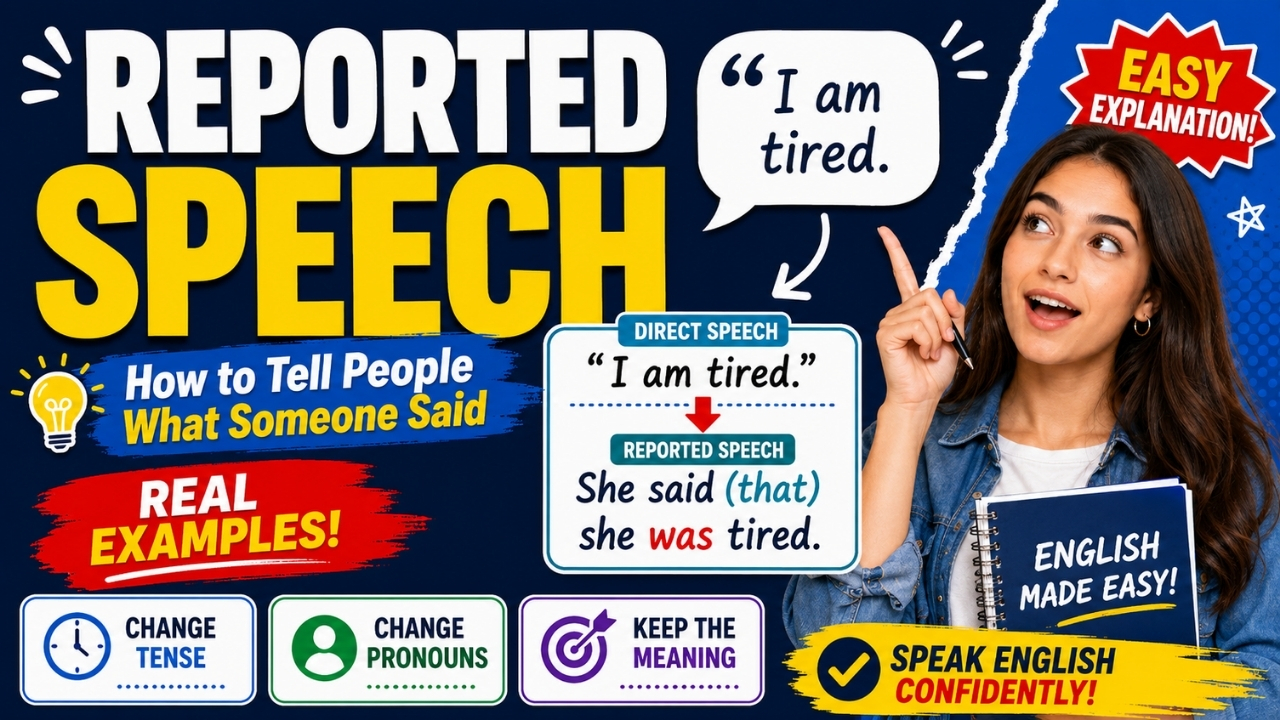
Every day you repeat what other people said — “She told me she was tired,” “He asked if I was coming.” In English, doing this involves a few systematic changes, and once you see the pattern, reported speech (also called indirect speech) stops feeling like a maze. Let’s walk through it step by step.
Direct vs. reported speech
Direct speech quotes the exact words, inside quotation marks: She said, “I am busy.” Reported speech tells the same message without quotation marks, usually after a reporting verb like said or told: She said (that) she was busy.
Notice three things changed: the quotation marks disappeared, “am” became “was,” and “I” became “she.” Those three kinds of change — tense, pronouns, and sometimes time words — are the whole game.
The golden rule: backshift the tense
When the reporting verb is in the past (said, told, asked), the tense of the original words usually shifts “one step back” into the past. This is called backshifting.
- Present simple → past simple: “I work here” → She said she worked there.
- Present continuous → past continuous: “I am working” → He said he was working.
- Present perfect → past perfect: “I have finished” → She said she had finished.
- Past simple → past perfect: “I saw it” → He said he had seen it.
- will → would: “I will help” → She said she would help.
- can → could: “I can swim” → He said he could swim.
- must → had to: “I must go” → She said she had to go.
You don’t need to memorise this as a table under pressure. Just remember the principle — move everything one step further into the past — and the specific forms follow.
Change the pronouns to match the new speaker
Because you’re now speaking about the original person rather than as them, the pronouns shift to keep the meaning true.
- Direct: Tom said, “I lost my keys.”
- Reported: Tom said he had lost his keys.
It feels obvious in a simple sentence, but it’s easy to forget in a longer one. Always ask: from my point of view now, who is this about?
Change time and place words too
If the original moment has passed, words that point to “now” and “here” need updating so they still make sense:
- now → then
- today → that day
- tomorrow → the next day / the following day
- yesterday → the day before
- here → there
- this → that
So “I’ll see you here tomorrow” becomes He said he would see me there the next day. Without these changes, the sentence can become confusing or even untrue.
Reporting questions
Questions need extra care, because two things happen at once.
Word order goes back to normal
In reported questions, you drop the question word order and use statement order — subject before verb — and no question mark.
- Direct: “Where do you live?”
- Reported: She asked where I lived. (Not “where did I live.”)
Yes/no questions need ‘if’ or ‘whether’
When the original question has no question word (who, what, where…), add if or whether:
- Direct: “Are you coming?”
- Reported: He asked if I was coming.
Reporting commands and requests
For orders, advice, and requests, you don’t backshift a tense — you use tell/ask someone + to + verb:
- Direct: “Sit down.”
- Reported: She told me to sit down.
- Direct: “Please don’t be late.”
- Reported: He asked me not to be late. (Note “not to” for negatives.)
When you don’t need to backshift
Here’s the relief: the backshift isn’t always required. If the thing said is still true now, or the reporting verb is in the present, you can often keep the original tense.
- “The Earth goes around the Sun.” → She said the Earth goes around the Sun. (Still true, so no shift needed.)
- “I love this song.” → He says he loves this song. (“Says” is present, so no shift.)
This is why you’ll see both “She said she was tired” and “She said she’s tired” — context decides whether the state still holds.
Say vs. tell — a small but important difference
These two reporting verbs aren’t interchangeable. Tell needs a person right after it; say does not.
- “He told me he was leaving.” ✓
- “He said he was leaving.” ✓
- “He said me…” ✗ and “He told he was leaving” ✗
A simple memory hook: you tell someone, but you just say something.
How to get comfortable with it
Reported speech becomes natural through repetition, not theory. Try this: after a conversation, a film scene, or a message, retell it to yourself — “She said she couldn’t come because she had to work.” Do it daily and the tense shifts, pronoun changes, and say/tell choice stop being calculations and start being reflexes. That’s the moment reported speech finally feels easy.