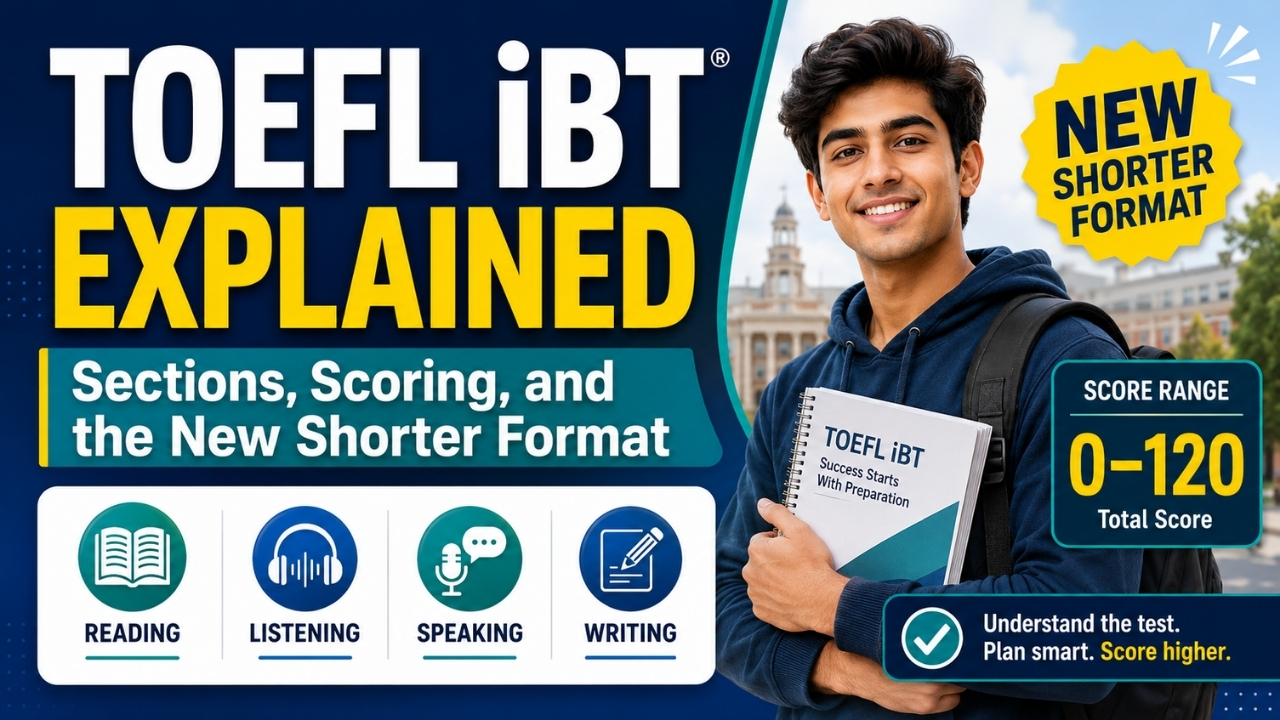
If your university asks for the TOEFL, they want proof you can handle English in an academic setting — reading textbook-style passages, following lectures, and expressing ideas clearly in speech and writing. It’s taken on a computer, and as of January 21, 2026 the test looks noticeably different from the version most online guides still describe. It’s shorter — you should plan for about two hours from check-in to finish, with under 90 minutes of actual testing time — and it now adapts to you as you go. If you remember the old three-hour-plus marathon, or even the trimmed-down version that ran from 2023 to 2025, the test you’ll sit today is a different animal. This guide walks through what it actually contains now, how the new scoring works, and how to prepare for it without wasting weeks on outdated materials.
A quick but important note before we start: a lot of “TOEFL format” articles, videos, and even prep books on the market right now still describe the pre-2026 test, complete with an independent speaking task and an integrated essay that no longer exist. If a resource talks about a 0–120 score as the main scale, four separate speaking tasks, or a “read a passage, listen to a lecture, then write about both” writing question, it hasn’t been updated. Knowing what’s genuinely on the test today is the first advantage you can give yourself.
What actually changed in 2026
ETS, the organisation that makes the TOEFL, rebuilt the test around three ideas: make it shorter, make it adaptive, and make the content feel closer to how students really use English. The headline changes are worth understanding before we go section by section, because they shape how you should study.
First, the test is now adaptive in its Reading and Listening sections. Instead of everyone seeing the same questions, the test delivers an opening set of items, then routes you into an easier or harder second set based on how you did. That has a real consequence: the harder path can earn the top band, while the easier path is capped at a lower ceiling. You don’t choose your path — your performance does — so there’s no “safe” strategy except answering as well as you can from the very first question.
Second, the scoring scale changed. The familiar 0–120 total is being phased out in favour of a 1.0 to 6.0 band scale that lines up more neatly with international language benchmarks. To smooth the transition, score reports for the first couple of years still show a comparable 0–120 figure alongside the bands, so universities that haven’t updated their published requirements can still read your result.
Third, the task types were overhauled across all four sections. Some classic tasks survived in spirit — you’ll still read academic passages and listen to lectures — but several familiar tasks were retired and replaced with shorter, more practical ones: completing missing words, reading everyday texts like emails and notices, repeating spoken sentences, answering interview-style questions, and writing a short email. The test feels less like one long academic exam and more like a series of quick, varied tasks.
The four sections
The TOEFL iBT still measures the same four skills — Reading, Listening, Speaking, and Writing — and the sections run back to back in a fixed order with no scheduled break. Because Reading and Listening adapt, the exact number of questions and the precise timing you experience can vary slightly from person to person, so treat the figures below as the standard shape of the test rather than a guarantee to the second.
Reading
The Reading section runs about 30 minutes and now mixes three kinds of task rather than just serving you long passages. The most traditional of them is Read an Academic Passage, where you work through textbook-style text and answer questions on main ideas, supporting details, vocabulary in context, and inference. As before, the passages are dense but self-contained — you never need outside knowledge of the subject, because everything required to answer is on the screen in front of you.
Alongside the academic passages, two newer task types reflect the test’s more practical turn. Complete the Words gives you a short academic paragraph in which some words are missing their second half, and you have to deduce the full word from context and spelling — a quick check of vocabulary and reading fluency rather than deep comprehension. Read in Daily Life presents brief, real-world texts such as emails, announcements, notices, or menus, and asks you to pull out the key information. These are short and shouldn’t intimidate you, but they reward careful reading: the details that answer the question are often easy to skim straight past.
Because this section is adaptive, your performance early on influences the difficulty of what comes next. The practical implication is simple but easy to forget under pressure: don’t sleepwalk through the opening questions assuming you’ll “warm up” later. Treat the first items as the most important ones you’ll see, because they help decide how high your ceiling can go.
Listening
Listening lasts roughly 29 minutes and, like Reading, blends familiar and new tasks. The backbone is still recorded academic talks and campus conversations — a professor explaining a concept, or two people sorting out a registration problem — where you listen once, take notes, and answer questions about the main point, the speaker’s attitude, and specific details. You hear each recording a single time, so there’s no replaying to catch a phrase you missed.
The section also includes shorter, more functional tasks. Listen and Choose a Response plays a brief spoken prompt and asks you to pick the most natural reply, testing whether you can follow conversational English in real time. Listen to an Announcement uses the kind of practical audio you’d actually encounter on a campus — a schedule change, a facility notice — and checks that you caught the essential information.
The single most useful habit here is good note-taking. You’re allowed scratch paper at a test centre, or a small whiteboard if you’re testing at home, and a clean system for jotting down the structure of a talk — main claim, two or three supporting points, any contrast or example — matters far more than a perfect ear for every word. Train yourself to capture the shape of what you hear, not a transcript. Trying to write down everything is the classic mistake; you end up missing the next sentence while finishing the last one.
Speaking
Speaking is now the shortest section — around 8 minutes — and it’s been completely redesigned. The old four-task format, with its “independent” opinion question and its integrated read-then-speak tasks, is gone. In its place are two task types, delivered through about a dozen short items, that focus on spontaneous, real-time communication.
Listen and Repeat does exactly what it sounds like: you hear a sentence about a campus or everyday topic and repeat it back into the microphone within a short recording window. It’s testing pronunciation, rhythm, and your ability to hold a spoken sentence in memory and reproduce it cleanly. The sentences get a little longer and trickier as you go, so the back half demands real focus.
Take an Interview simulates a short conversation: a video prompt asks you a series of questions on a given topic, and you answer each one aloud. There’s no preparation time, and you have around 45 seconds per answer. The questions tend to escalate — starting with simple factual or descriptive prompts and moving toward giving an opinion or explaining a choice. Because there’s no prep window, the skill being measured is genuine fluency under mild pressure: can you start talking immediately, organise a thought on the fly, and keep going for the full window without long silences?
The practical takeaway is that you can’t lean on memorised templates the way the old independent task sometimes allowed. What helps instead is rehearsing the act of responding instantly — record yourself answering everyday questions in 45-second bursts until starting without hesitation feels normal. A short, clear, well-connected answer beats an ambitious one that stalls halfway through.
Writing
The Writing section runs about 23 minutes and now contains three task types, none of which is the old integrated “read a passage, hear a lecture, write about how they relate” essay — that task has been retired. If you’ve been preparing for it, you can set that practice aside.
Build a Sentence is a short, focused task that checks your control of grammar and word order by having you assemble a correct sentence. It’s quick, but it rewards a solid grasp of English structure, so it’s a good reason not to neglect the grammar fundamentals while you chase the bigger tasks. Write an Email asks you to compose a short, appropriate message for a realistic situation — a request, a follow-up, a reply to campus correspondence. Here, tone and clarity matter as much as accuracy: you’re being judged on whether you can pitch a message at the right level of formality and get your point across efficiently.
The most substantial task is Write for an Academic Discussion, which carried over from the previous version of the test. You’re shown an online class discussion — a professor poses a question and a couple of students have already replied — and you add your own short, well-argued post in about ten minutes. A strong response states a clear position, gives a specific reason or example to support it, and engages briefly with what the other students said rather than ignoring them. Graders are looking for a focused contribution with concrete detail, not a long, vague essay. Aim for tightly organised paragraphs and at least one developed example; a short answer that genuinely advances the discussion scores better than a longer one that just restates the prompt.
Because Speaking and Writing responses are now scored largely by an automated engine trained on human ratings (with human oversight), the qualities that score well are exactly the ones good writing teachers have always pushed: clear structure, relevant support, accurate grammar, and natural phrasing. There’s no trick to game — there’s just doing the things that make writing clear.
How TOEFL scoring works now
Each of the four sections is scored on a 1.0 to 6.0 band scale, and your overall score is the average of the four section bands, rounded to the nearest half band. So if your section scores average out to, say, 5.125, your overall comes back as 5.0; an average of 4.75 would round to a reported overall in half-band steps. This is a real shift from the old approach, where the four 0–30 section scores were simply added to produce a total out of 120.
To keep things readable during the changeover, score reports for a two-year transition period after January 2026 also show a comparable overall score on the old 0–120 scale. That matters because many universities published their requirements in 0–120 terms — commonly something in the 80–100 range overall, often with minimums for individual sections — and haven’t yet restated them in bands. The comparable score lets an admissions office map your band result onto the number they’re used to.
Because requirements vary so much between programs, the single most important thing you can do before you book is check the exact requirement for your course, in whichever scale they state it. A strong overall score won’t rescue you if you fall below a section minimum, and section minimums are common — a program might accept a solid overall but still insist on a particular floor for Speaking or Writing. Read the requirement carefully and, if it’s ambiguous, contact the institution directly rather than guessing.
One feature worth knowing about is the MyBest score, which combines your highest section scores from all the TOEFL tests you’ve taken in the previous two years into a single best-possible profile. In practice, that means one weak section on an otherwise strong test day is far less catastrophic than it used to be: if you nail Speaking on one attempt and Writing on another, MyBest stitches your best of each together. Always confirm, though, whether your target university actually accepts MyBest scores, because not all of them do.
What “adaptive” means for you on test day
The adaptive design in Reading and Listening is the change most likely to catch unprepared test-takers off guard, so it’s worth understanding plainly. Each of those two sections is built in stages. Everyone starts with the same opening set of questions. Based on how you perform there, the test routes you into a second set that’s either easier or harder. The harder route is where the top of the scale lives; the easier route is capped below the ceiling, meaning even a perfect run through easy questions can’t reach the highest band.
There are two honest consequences of this. The first is that your early answers carry extra weight, because they help determine which path you’re sent down — so there’s no warming-up phase to coast through. The second is that you generally can’t move backward and forward freely the way you might on a fixed test; within an adaptive flow you commit to your answers as you go. Practising with materials that actually replicate this stage-based structure, rather than a flat fixed-form mock, will make test day feel familiar instead of disorienting.
A note on the shorter format
The 2026 update didn’t make the test easier — it made it tighter. There are fewer, shorter tasks, which means less room to recover from a slow start, and there’s no scheduled break to reset between sections. That puts a real premium on pacing and on walking in already comfortable with each task type, including the newer ones that didn’t exist a couple of years ago. You can’t afford to spend the first few minutes of any section figuring out what it’s even asking.
It also rewards stamina of a particular kind: the test moves quickly through a variety of formats, so the ability to switch gears — from completing words to reading an email to repeating a spoken sentence — without losing your composure is itself a skill. The more of these task types you’ve rehearsed, the less mental energy each one costs you on the day, leaving you sharper for the tasks that actually carry the most weight.
How to build a study plan that fits the real test
The advice that matters most early on is simple: take one full, official practice test before you build your study plan. There’s no point grinding through reading drills if your real weakness is starting a spoken answer without hesitating, and you can’t know which it is until you’ve sat a realistic mock under timed conditions. A proper diagnostic shows you where your actual gap is, so you can spend your limited weeks improving the thing that’s costing you points instead of the thing you assumed was the problem.
From there, a few principles hold up well. Use materials that reflect the current 2026 format — official ETS practice in particular — and be ruthless about discarding anything built around the old structure, because practising retired task types is worse than useless; it teaches you to expect a test you won’t see. Study a little consistently rather than cramming, since language skills build through repetition over time, not in a single heroic weekend. After every practice session, review your mistakes properly: understanding why an answer was wrong is what stops you repeating it. And practise under realistic timing, with the clock running and no pauses, so the pacing of the real thing doesn’t surprise you.
If your weak area is Speaking, build the habit of answering everyday questions out loud in 45-second windows with no prep. If it’s Writing, draft short academic-discussion posts and emails to time, then check them for structure and grammar rather than just length. If it’s Reading or Listening, prioritise practice that mimics the adaptive, stage-based flow. Targeted practice on your real weak spot will move your score far more than another general run-through of the whole test.
TOEFL or IELTS?
If you’re still choosing which test to take, the honest answer is that neither is objectively harder — it comes down to your strengths and preferences. The TOEFL is entirely computer-based, English-only, and built around structured academic tasks, with Speaking recorded into a microphone rather than spoken to a person. If you’re comfortable typing, working on screen, and talking to a recording, the TOEFL tends to suit you. If you’d rather write by hand and speak to a live examiner, IELTS may feel more natural. Both are widely accepted, so the more important question is usually which one your target universities or immigration authorities require, and which format plays to how you actually perform.
The bottom line
The TOEFL iBT in 2026 is shorter, adaptive, scored in bands, and rebuilt around tasks that look a little more like real academic and campus life. The skills underneath haven’t changed — read carefully, listen actively, speak fluently, write clearly — but the packaging has, and the gap between people who know the current format and people working from old guides is real. Get a current diagnostic, practise the tasks that actually exist today, and confirm exactly what your program requires before you book. Do that, and the new format stops being a source of anxiety and becomes just another exam you’ve prepared properly for.