There is a strange plateau in English. You stop making beginner errors, you understand films, you hold conversations without effort – and yet a native speaker still hears something slightly off. The mistakes that survive this long are rarely dramatic. They are small, fossilised habits: a preposition that was never corrected, a noun you have always made plural, a word that means something different in your first language. Nobody stops you to fix them, so they stay.
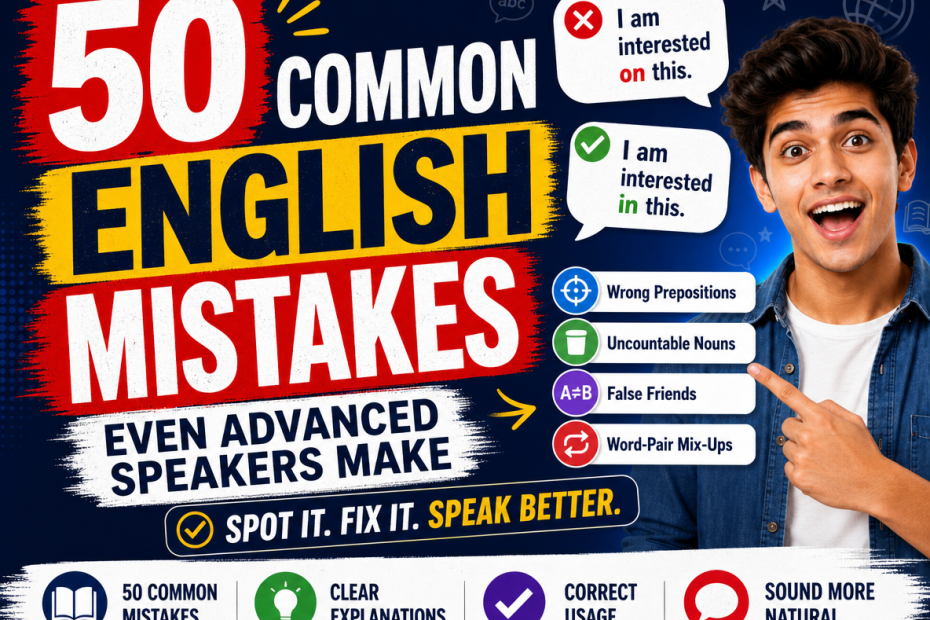
Here are fifty of the most common ones, grouped by the reason they happen. Read them with a pen. Most learners recognise between five and fifteen of their own.
Prepositions that stick to the wrong verb
Prepositions are learned as a package with the verb, and if the package was wrong the first time, it stays wrong for years. These are the ones that appear most often in advanced writing.
- Not discuss about the problem – just discuss the problem. The verb already contains the idea.
- Not depends of – depends on.
- Not married with someone – married to someone.
- Not interested about – interested in.
- Not good in English – good at English.
- Not listen music – listen to music. But watch a film, with nothing between.
- Not arrive to London – arrive in London (cities, countries) or arrive at the station (buildings, points).
- Not explain me the rule – explain the rule to me. Explain never takes a person directly.
If prepositions of time are also a soft spot, the in/on/at system is worth fixing properly – it is covered in Prepositions of Time: In, On, At.
Nouns that cannot be counted
English decided that certain nouns are substances rather than objects, and substances do not take a plural. The logic is not always obvious, which is why these survive so long.
- Not informations – information. For one item: a piece of information.
- Not advices – advice. Again: a piece of advice.
- Not furnitures, equipments, softwares, homeworks, researches – all stay singular.
- Not a knowledge – knowledge, with no article, unless you mean a knowledge of Spanish.
- People is already plural: people are, never people is. Peoples exists only for ethnic groups.
- News looks plural but is singular: the news is good.
- The police looks singular but is plural: the police are investigating.
- Not less mistakes – fewer mistakes. Fewer for things you can count, less for things you cannot.
Verb forms that slipped through
These are the errors that appear when you are speaking fast and the brain reaches for the nearest shape.
- Not I am agree – I agree. Agree is a verb, not an adjective.
- Not I didn’t went – I didn’t go. Once did carries the past, the main verb goes back to base form.
- Not he don’t – he doesn’t.
- Not everybody are – everybody is. Every word ending in -body or -one is singular.
- Not I have went – I have gone. Perfect tenses need the third form, not the past.
- Not if I will go – if I go. The if half of a sentence stays in the present.
- Not I wish I would have known – I wish I had known.
- Not more better or most cheapest – better, cheapest. Never double the comparison.
The if point in particular is worth ten minutes of attention, because it spreads across four different patterns. The Four Conditionals lays them out side by side.
The present perfect problem
This deserves its own section, because it is the single most persistent grammar error at advanced level – and it is usually caused by the way the same idea works in your first language.
- Not I live here since 2019 – I have lived here since 2019. Something that started in the past and is still true needs the present perfect.
- Not since three years – for three years. Since takes a starting point, for takes a length.
- Not I have seen him yesterday – I saw him yesterday. A finished time word forces the past simple.
- Not When have you arrived? – When did you arrive? When asks about a finished moment.
If any of those four felt uncomfortable, the full distinction is worked through in Present Perfect vs. Past Simple.
False friends: words that betray you
These words exist in your language and in English, look almost identical, and mean something different. They are dangerous precisely because you feel confident using them.
- Actually does not mean currently. It means in fact. For the other meaning, use currently or at the moment.
- Eventually does not mean possibly. It means in the end, after a while. For the other meaning, use possibly or if necessary.
- Sympathetic does not mean friendly. It means showing understanding for someone’s suffering. For a warm person, say friendly or likeable.
- Sensible means showing good judgement. Sensitive means easily affected emotionally. They are not interchangeable.
- Assist means help, not attend. You attend a meeting.
- Realise means become aware of, not carry out. You carry out a project.
- Support means help or endorse, not tolerate. To tolerate something unpleasant is to put up with it.
- Pretend means act as if something false were true, not intend or claim.
Word pairs that native speakers also confuse
Some of these are pure spelling, some are meaning, and all of them are visible in writing.
- Its shows possession. It’s is it is. If you cannot expand it to it is, there is no apostrophe.
- Your shows possession. You’re is you are.
- Their is possession, there is place, they’re is they are.
- Then is time. Than is comparison.
- Lose is the verb. Loose means not tight.
- Advice is the noun, advise is the verb. Same pattern for practice and practise in British English.
- Everyday is an adjective (an everyday problem). Every day is a frequency (I study every day).
- Affect is usually the verb, effect usually the noun.
There is a longer collection of these traps, including the ones that survive spellcheck, in Confusing Word Pairs.
Errors that come from how English sounds
A small group of mistakes exist only because two things sound identical in fast speech. Learners write what they hear, and what they hear is misleading.
- Not could of, should of, would of – always could have, should have, would have. In speech the contraction could’ve genuinely sounds like of.
- Not alot – a lot, two words.
- Not would like to went – would like to go.
- Not I am use to it – I am used to it. The d disappears in speech but stays in writing.
- Not photo’s or the 1990’s for plurals – photos, the 1990s. An apostrophe is not a plural marker.
This category is a symptom rather than a cause. If words seem to melt into each other when natives speak, the mechanism behind it is explained in Connected Speech.
Verb pairs that swap places
English has several pairs where the difference is direction or perspective rather than meaning, and getting them the wrong way round is very noticeable.
- Borrow is to take; lend is to give. Can I borrow your pen? / Can you lend me your pen?
- Bring is towards the speaker; take is away from the speaker.
- Say takes the words; tell takes the person. He said he was tired / He told me he was tired. Never he said me.
- Learn is what a student does; teach is what a teacher does.
- Do a task, make a mistake. Never do a mistake.
- Take a photo, not make a photo.
- Hear is passive, listen is deliberate. Same for see and watch.
The say/tell and borrow/lend distinctions become critical the moment you report someone else’s words, which is where Reported Speech picks up.
Adjectives ending in -ed and -ing
One tiny rule, an enormous amount of confusion. The -ing form describes the thing; the -ed form describes the person feeling it.
- Not I am boring (unless you genuinely are) – I am bored.
- Not I am very interesting in music – interested in.
- The film was confusing, so I was confused.
- Also note: fun means enjoyable, funny means it makes you laugh. A party is fun; a joke is funny.
Phrases that reveal a translated sentence
These are grammatically possible but no native speaker says them. They are almost always word-for-word imports.
- Not How is it called? – What is it called?
- Not I have a doubt – I have a question. In English, doubt means you suspect something is untrue.
- Not I have 25 years – I am 25.
- Not Me and John went in writing – John and I went. Test it by removing the other person: I went, not me went.
- Not I am here since Monday – I have been here since Monday.
- Not Thanks God – Thank God.
That last group is the clearest sign that a sentence is being assembled in one language and delivered in another. It is a habit rather than a knowledge gap, and it responds well to the training described in How to Stop Translating in Your Head.
What to actually do with this list
Do not try to fix fifty things. It does not work, and you will remember none of them by Friday.
Instead, pick the three that made you wince – the ones where you thought I do that constantly – and write them on something you will see this week. For the next few days, look for those three specifically in your own writing and speech. Three corrections that actually stick are worth more than fifty you skimmed.
And keep one thing in perspective. Every item on this list is a mistake made by people who speak English well. Beginners do not confuse sensible with sensitive, because beginners do not use either word. These errors are evidence of range. Cleaning them up is polishing, not repair – and polishing is the fastest visible progress available at this level.